Development & Speech · Entry
16 Month Old Milestones: What Most Toddlers Do Now
The 16 month old milestones most toddlers are working on: steadier walking, a few real words, pointing, copying chores, plus what to watch and when to ask.

At sixteen months, most toddlers are walking or nearly walking, saying one or two words besides “mama” and “dada”, pointing to ask for things, handing you a toy when you hold out your hand and ask, and copying the things you do around the house. There is no official checklist for this exact age. The CDC publishes milestone checklists at 15 months and 18 months, so a sixteen-month-old is best read as somewhere on the road between those two lists: past most of the first, working toward the second.
Why there is no 16-month checklist
The CDC’s lists describe what most children do by a given age. They are a screening floor, not an average, and they are set at the ages when children usually see the doctor. In the US well-child schedule there is a visit at fifteen months and another at eighteen, so sixteen months falls in the gap.
That is useful to know for two reasons. First, if your child does something on the 18-month list early, that’s lovely and it means nothing in particular. Second, a skill from the 15-month list that is still missing at sixteen months is not a crisis, but it is worth writing down for the next visit rather than waiting to see.
Movement: from first steps to steady walking
The 15-month list includes “Takes a few steps on his own.” The 18-month list asks for more: “Walks without holding on to anyone or anything” and “Climbs on and off a couch or chair without help.”
Sixteen months is often the month in between, when walking stops being an event and starts being how your child gets around. You may notice:
- fewer falls, and quicker recovery when they do fall
- walking while carrying something, which takes real balance
- stooping to pick up a toy and standing again
- the first attempts at climbing onto the sofa, usually before they have worked out how to get down
Betteroo has a by-age look at these big-muscle skills if you want to see where running and jumping come next.
If your toddler is not walking yet, the range for first steps is wide, and many typically developing children take them later than their playgroup friends. A child who is not taking any steps on their own is worth raising with the pediatrician, which is exactly what the 15-month item is there to prompt.
Hands: stacking, scribbling and feeding
On the 15-month list, children stack “at least two small objects, like blocks” and use “fingers to feed herself some food.” By 18 months the list adds “Scribbles,” “Tries to use a spoon” and “Drinks from a cup without a lid and may spill sometimes.”
At sixteen months you’ll often see the beginnings of all three. A chunky crayon held in a fist, such as Crayola’s My First Palm-Grip Crayons, produces big back-and-forth marks with no picture in mind. The spoon is gripped with enthusiasm and turned over on the way to the mouth. Cups are a two-handed affair with a lot of spilling. All of that is normal; the mess is the practice. Our fine motor milestones entry follows these skills through to age three.
Language: one or two words, and a lot of pointing
The 15-month list asks for a child who “Tries to say one or two words besides ‘mama’ or ‘dada,’ like ‘ba’ for ball or ‘da’ for dog.” By 18 months it is “three or more words besides ‘mama’ or ‘dada’.” So at sixteen months, a toddler with one, two or three words is right where the lists expect.
Two things matter more than the count:
- Pointing. The 15-month list includes “Points to ask for something or to get help,” and the 18-month list adds “Points to show you something interesting.” Pointing to show you something, then checking your face, is one of the strongest signs that language is on its way.
- Following directions. At 15 months the CDC expects a child to follow a direction given “with both a gesture and words.” At 18 months it is “one-step directions without any gestures.” Try saying “give me the cup” without holding out your hand. A sixteen-month-old who manages it sometimes is right on track.
Approximations count as words. “Ba” used for every ball is a word. So is a consistent animal sound used to mean the animal.
Social and emotional: copying, showing and checking back
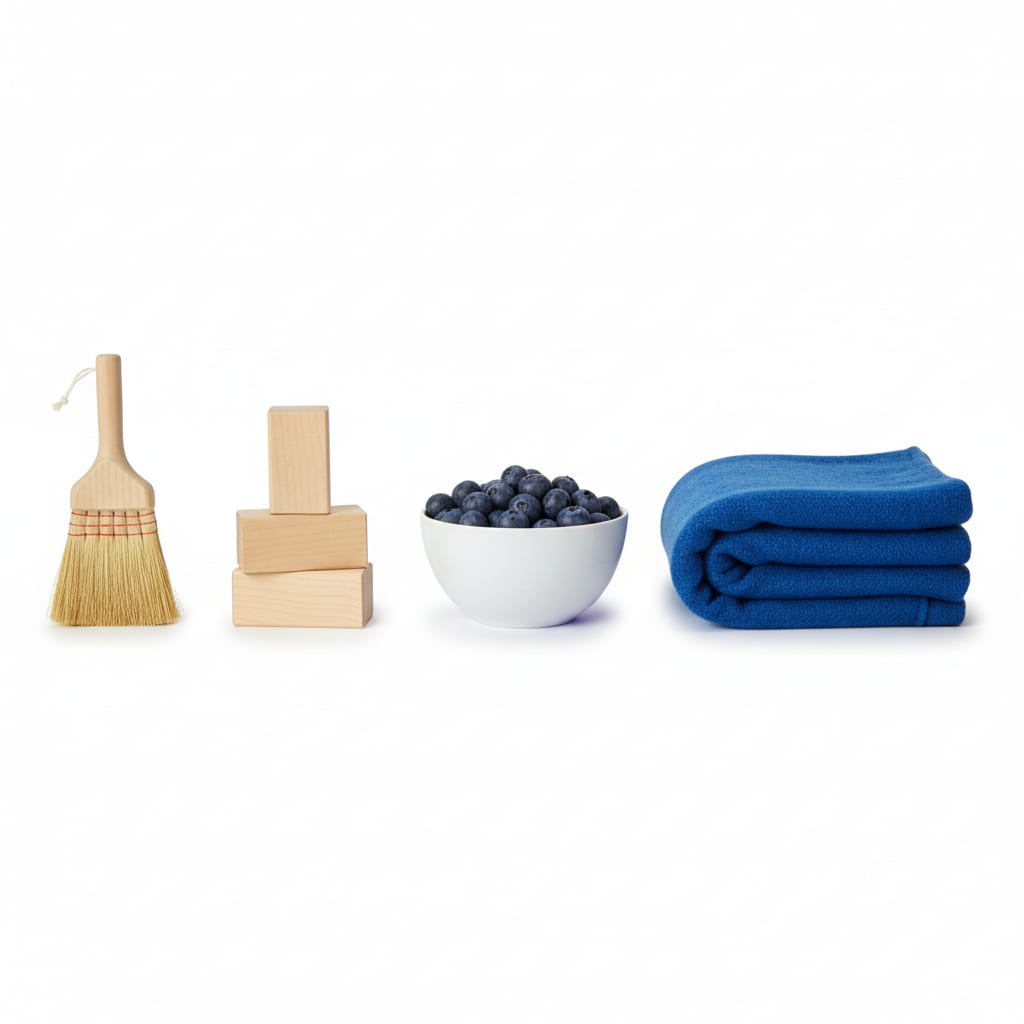
Sixteen-month-olds are copycats. The 18-month list includes “Copies you doing chores, like sweeping with a broom,” and many children start well before that. Give them a cloth and they will wipe the table. Pick up your keys and they will want a set.
They also start to move away from you on their own, then look back to make sure you’re still there. The 18-month list describes this as “Moves away from you, but looks to make sure you are close by.” It looks like independence. It is really a child using you as a safe base.
Clinginess with strangers, protest at drop-off and a strong preference for one parent are all common at this age, and none of them are signs of a problem.
Field note: the sixteen-month-olds I worried about least were the ones who brought me things. Not to ask for help, just to show me a leaf or a block and watch my face. That little loop of “look, look at me looking” told me more than any word count.
Sleep and the sixteen-month stretch
New skills tend to show up at night. A child who has just learned to stand steadily may practise in the cot at 2 a.m., and the push for independence can make bedtime harder. Most toddlers are on a single nap by now, or close to it. The 16 month old schedule entry has a sample one-nap day and fixes for the late-afternoon slump.
When to talk to your pediatrician
The CDC’s advice on every checklist is the same: “You know your child best. Don’t wait.” If you are worried, it says to “act early” and to “Talk with your child’s doctor, share your concerns, and ask about developmental screening.” In the US, you can also contact your state’s early intervention program directly; the CDC lists the numbers at cdc.gov/FindEI.
Two things are always worth a prompt call rather than a wait, at any age:
- losing a skill your child used to have
- a persistent feeling that something is not right
Where sixteen months sits in the arc
The checkpoint before this is the 15 month old milestones entry, which covers the 15-month well-child visit. The next rung is 17 month old milestones, when the word count often starts to climb.
Nothing here is medical advice or a screening tool. It is a well-organized head start for the conversation with your child’s doctor.
FAQ: 16 month old milestones
How many words should a 16 month old say?
The CDC lists bridge it. At 15 months most children try one or two words besides “mama” and “dada”; by 18 months most have three or more. So one to three words at sixteen months is expected, and approximations count.
Should a 16 month old be walking?
Many are, and many are just getting steady. The CDC’s 15-month list includes taking a few steps alone, so a sixteen-month-old who is not stepping on their own at all is worth mentioning to the pediatrician.
Is there a 16-month checkup?
Not in the standard US schedule. Visits usually fall at 15 and 18 months, which is why the CDC has checklists at those ages and not at sixteen. You don’t need to wait for a visit to call with a concern.
My 16 month old points but does not talk. Is that okay?
Pointing to ask and pointing to show are strong signs that language is developing. Keep naming what they point at. If there are no words at all by 18 months, or pointing stops, raise it with the pediatrician.