Toddler Fine Motor Milestones: Grip, Scribble, Scissors
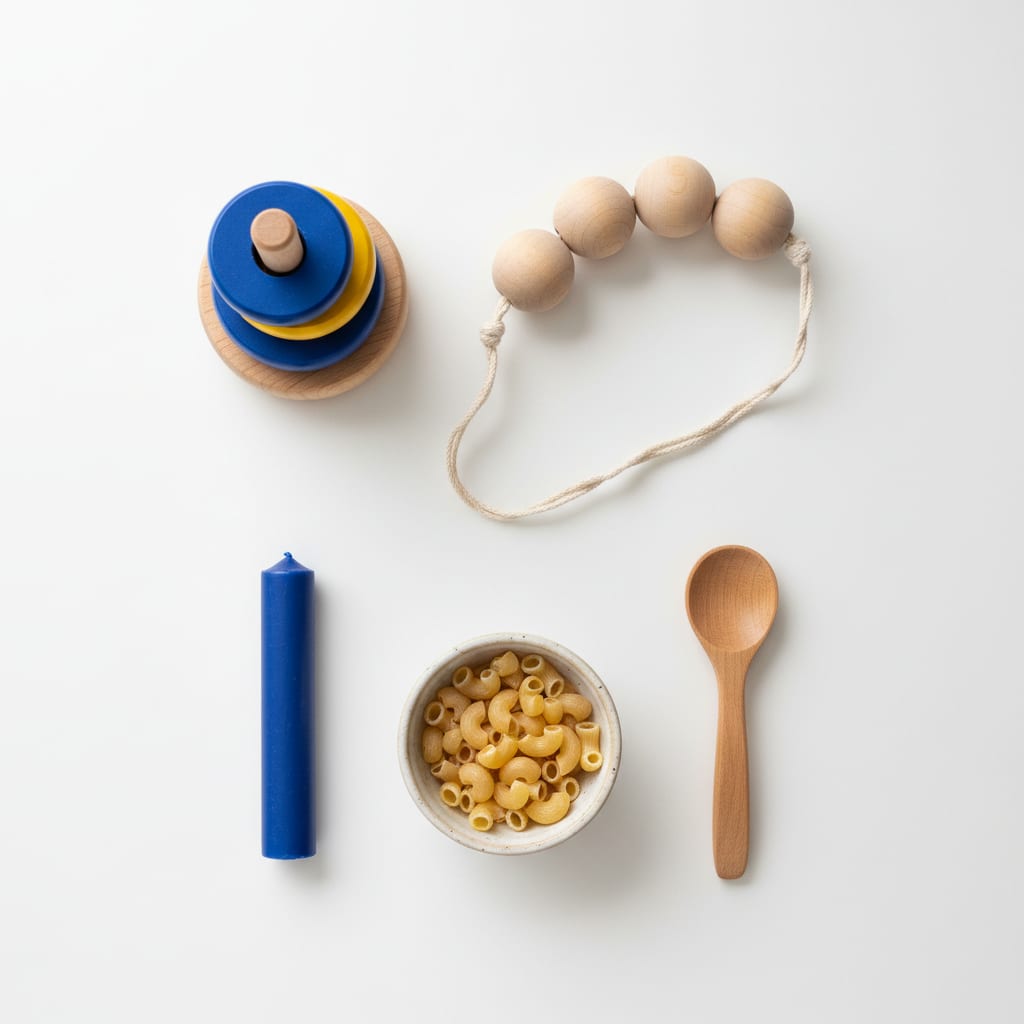
Fine motor development between one and three is the slow business of a hand learning to do two different things at once. The CDC’s checklists — revised in 2022 and quoted directly below — place the pincer grasp at around twelve months, stacking two blocks at fifteen, scribbling at eighteen, spoon-feeding at two, twisting lids and turning single book pages at two and a half, and stringing beads, using a fork and copying a circle at three. Those are ranges built around what most children do, not deadlines. Scissors, notably, do not appear anywhere on the list.
What the CDC checklists are, and what they are not
This matters more than any single item on them. When the CDC revised its Learn the Signs. Act Early. checklists in 2022, it changed the standard a milestone has to meet: the listed skills are ones 75% or more of children can do by that age. The older convention, which many charts still follow, was the average — roughly half. So a CDC milestone is deliberately set at a point where most children are already past it, precisely so that a child who has not reached it is worth a conversation rather than a shrug.
The 2022 revision also moved and reworded items, added checklists at fifteen and thirty months, and removed some skills entirely. Which is why “check, don’t recall” is the rule here: a chart you half-remember from a baby book is probably quoting the pre-2022 list at a different percentile.
The hand skills on each checklist, age by age
Taken verbatim from the current CDC checklists, restricted to the items involving hands:
| Age | What the CDC lists |
|---|---|
| 12 months | Picks things up between thumb and pointer finger, like small bits of food; drinks from a cup without a lid, as you hold it; puts something in a container, like a block in a cup |
| 15 months | Uses fingers to feed herself some food; stacks at least two small objects, like blocks; tries to use things the right way, like a phone, cup, or book |
| 18 months | Scribbles; tries to use a spoon; feeds himself with his fingers; drinks from a cup without a lid and may spill sometimes; helps you dress him by pushing arm through sleeve or lifting up foot |
| 24 months | Eats with a spoon; holds something in one hand while using the other hand, for example holding a container and taking the lid off; tries to use switches, knobs, or buttons on a toy |
| 30 months | Uses hands to twist things, like turning doorknobs or unscrewing lids; turns book pages, one at a time, when you read to her; takes some clothes off by himself |
| 36 months | Strings items together, like large beads or macaroni; uses a fork; puts on some clothes by himself; draws a circle, when you show him how |
Read down the right-hand column and the actual storyline appears, and it is not about drawing. It is about a hand that starts by grabbing one thing and ends the toddler years able to stabilise with one hand while manipulating with the other. Cutlery, dressing and threading are that one shift applied to different objects. The age-by-age entries for fifteen months, eighteen months and two years put each item back in the context of the whole checklist.
How a grip actually develops
The CDC lists only one milestone about how a crayon is held, and it sits at four years: “holds crayon or pencil between fingers and thumb (not a fist).” That single placement resolves most of the anxiety on this topic, because it tells you that a fist grip through the whole of toddlerhood is entirely expected.
The finer progression comes from occupational-therapy descriptions rather than the CDC, and is a sequence rather than a schedule: a whole-hand or fisted grasp first, with movement coming from the shoulder; then a finger grip with the hand turned down, moving from the elbow; then a three-finger grip moving from the wrist; finally the mature grip in which the fingers do the work. Toddlers live in the first two stages, which is why big movements on big surfaces suit a toddler hand better than a pencil and a small sheet.
Scribbling is a milestone; a circle is a different one
The gap between the two is instructive. Scribbling appears at eighteen months and is essentially a motor event — the arm moves, the crayon leaves a mark, and the mark is a by-product. Copying a circle appears at three and is a cognitive event as much as a motor one: the child has to hold a shape in mind, plan a path, close it, and stop. Eighteen months sit in that gap, and most of what fills them is not in the fingers.
Between the two come the intermediate marks parents worry about because they do not look like anything: back-and-forth lines, dots, spirals, then deliberate separate strokes. All normal territory — and the CDC lists no drawing milestone at all between eighteen and thirty-six months. Betteroo’s rundown of what an eighteen-month-old is typically doing is a reasonable cross-check for that end of the range, and their sixteen-month rundown covers the month before it.
Scissors are not on the list at all
The question comes up constantly — “when should my toddler be able to use scissors?” — and it has no CDC answer at any age up to and including four. Cutting is a preschool curriculum expectation rather than a developmental milestone, and the distinction is real: it is taught in a setting where scissors are handed out, not something that appears on its own the way scribbling does.
So if a nursery mentions scissor skills, they are describing an activity your child is being introduced to, not a benchmark being missed. The capacities that make cutting possible — a stable non-dominant hand holding the paper, an open-and-close motion isolated from the arm — are the ones already on the checklists above.
The self-care skills that are really hand skills
Half of the toddler fine motor list is disguised as dressing and eating. Pushing an arm through a sleeve at eighteen months, taking off loose clothes at thirty months, putting on loose pants at three: each is a two-handed coordination problem with a built-in reason to persist. The same is true of the twisting milestone, which is why jars, doorknobs and screw-top containers do more for a toddler hand than most toys marketed for the purpose.
What to actually put in front of a toddler belongs to our sister site; their activities for one-year-olds is the right stop. Our three-year milestone entry picks the thread up at the far end.
When to talk to your pediatrician
The CDC’s own framing is that a missed milestone is a reason to ask, not a diagnosis. Raise fine motor development at a checkup if your child is not doing the items listed for their age; if they use one hand markedly more than the other before around eighteen months; if they lose a hand skill they previously had; if hands seem persistently stiff, floppy or tremulous; if they avoid using both hands together well past two; or if feeding themselves, holding a cup or handling small objects is much harder than it looks for same-age children. Nothing here is medical advice — it’s a well-organized head start for that conversation.
FAQ: toddler fine motor skills
My two-year-old holds a crayon in a fist. Is that a problem?
Almost certainly not. The CDC does not expect a crayon held between fingers and thumb until four, and a fisted grip driven from the shoulder is the normal toddler pattern. Grip matures on its own given plenty of mark-making.
When should a toddler stack blocks?
The CDC lists stacking at least two small objects at fifteen months. Taller towers follow, but there is no CDC milestone for a specific number of blocks after that.
Is left- or right-handedness settled in toddlerhood?
Usually not. Hand preference commonly fluctuates through the toddler years and firms up later. The pattern worth mentioning is the opposite one — a strong, fixed preference very early — because it can indicate the other hand is being avoided.
Does my toddler need special toys for fine motor development?
No. The milestones above are met on cups, spoons, lids, doorknobs, clothing and crayons. Everyday objects that resist slightly supply the same practice as anything sold for the purpose.
See also: nearby entries
14 Month Old Schedule (With Nap Transition Notes)
July 19, 2026

18 Month Old Fighting Sleep: Defiance or Regression?
July 23, 2026
15 Month Sleep Regression: Why It Hits and What Helps
October 7, 2026