Toddler Needs to Hold Your Hand to Fall Asleep? What Helps
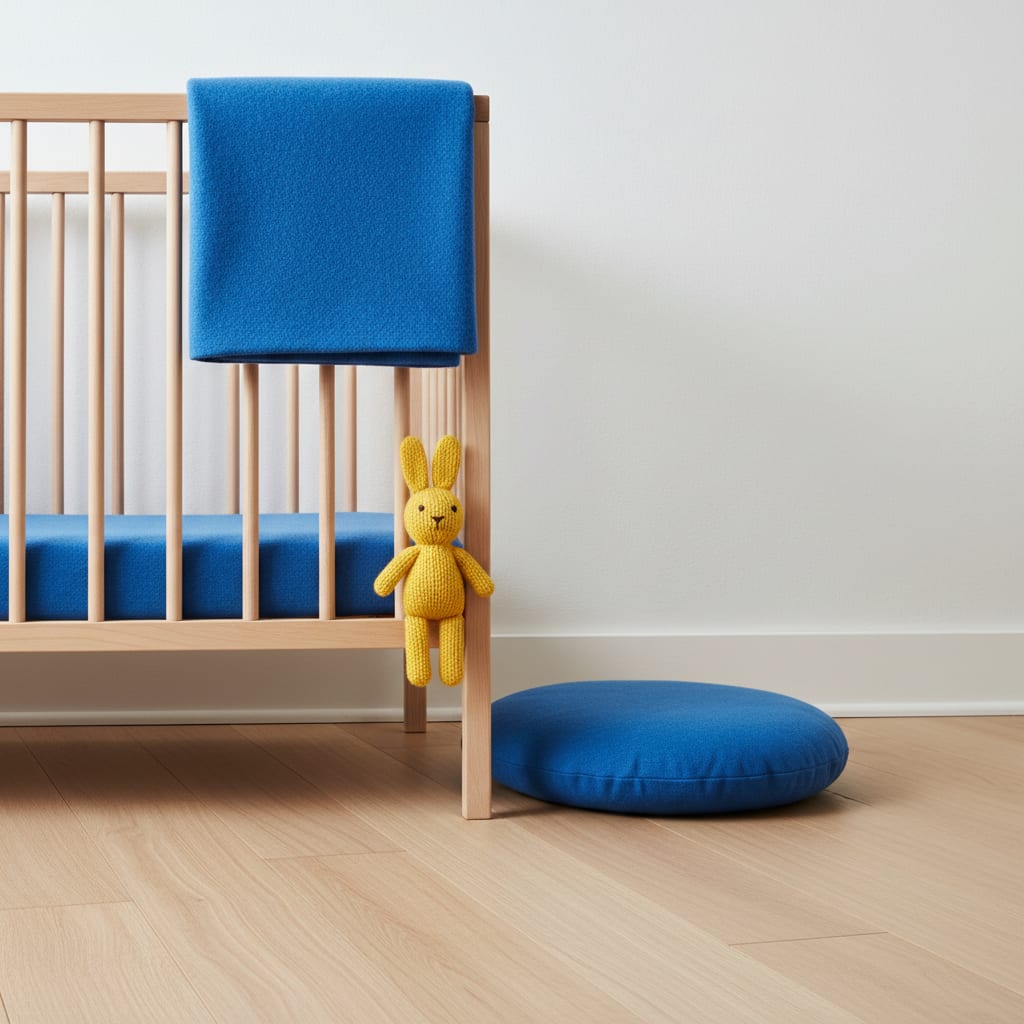
A toddler who needs to hold your hand through the crib bars to fall asleep has learned that your hand is part of how sleep starts. That is common, and it is not a problem in itself. It only needs changing if it is spreading into the night: if your child wakes two or three hours later and needs the hand again, or if only one parent can do bedtime. Then the fix is to fade the hand slowly, in small steps every few nights, rather than take it away in one go. A soft lovey can take over part of the job after the first birthday.
Why the hand works
The hand is a sleep-onset association: one of the conditions your child falls asleep under. The Society of Behavioral Sleep Medicine’s overview of childhood insomnia describes this type as children who “need to be with a specific item or person to fall asleep or get back to sleep after awakening.”
Pediatric sleep physician Craig Canapari explains why it carries into the night in his guide to toddler night wakings. Everyone wakes briefly between sleep cycles. If a child falls asleep under circumstances that are gone during the night, “they will need the same set of circumstances multiple times during the night.” He puts the typical age for this at 6 to 36 months and notes that “the first awakening typically occurs 2-3 hours after falling asleep.”
A toddler who wakes at 10pm calling for you is surfacing, noticing the hand is gone, and asking for what was there when they fell asleep.
Age plays a part too. The AAP’s page on separation anxiety and sleeping says a child in this stage may cry for one or both parents at night, “often expressing a strong preference for one,” and that it “usually fades away somewhere around the second birthday.”
Does it need to change?
Only if it is causing a problem.
| Leave it alone if… | Consider fading it if… |
|---|---|
| Your child falls asleep within a few minutes | Bedtime takes 30 minutes or more on the floor by the crib |
| The night is mostly unbroken | Your child wakes and needs the hand again, often 2 to 3 hours after sleep |
| Either parent or a sitter can do it | Only one person’s hand will do |
| It feels like a nice end to the day | Your back, arm or patience are paying for it |
If your child is waking a lot, our guide to why toddlers wake at night separates this pattern from the other common causes.
Is an arm through the crib bars safe?
In a modern crib, yes. The spacing rule is about heads. The AAP’s crib-buying guidance says bars should be “no more than 2 3/8 inches apart,” a standard “intended to make it impossible for a baby’s head to become caught.” Its page on sleeping sites adds that all new cribs must meet this 2011 standard but older cribs may not. If yours is antique or a hand-me-down of unknown age, measure the gaps.
Don’t add padding to keep arms in. The AAP says crib bumpers “should not be used”: there is no evidence they prevent serious injuries, and they carry risks of “suffocation, strangulation, or entrapment.”
How to fade the hand, step by step
The method is a gradual retreat. An NHS trust’s gradual retreat handout describes it as a parent moving to “the next degree of physical separation every few days” until they are out of the room. In its example, the parent moves on every fourth night, “resisting pleas from the child to return to their previous position.” The handout is written for a child in a bed. Here is the same idea for a crib:
| Step | What your hand does | Stay for |
|---|---|---|
| 1 | Holds their hand through the bars, as now, but goes still and quiet | 3 to 4 nights |
| 2 | Rests open beside their hand, so they hold you rather than you holding them | 3 to 4 nights |
| 3 | Rests on the mattress or blanket near them, not touching | 3 to 4 nights |
| 4 | Rests on the top rail of the crib, in sight | 3 to 4 nights |
| 5 | You sit right by the crib, hands in your lap, a calm word if needed | 3 to 4 nights |
| 6 | Your seat moves partway to the door, then to the doorway | a few nights each |
| 7 | You leave after the routine, and check briefly if needed | — |
Four rules keep it moving:
- Do the same at 2am as at bedtime. If you are on step 3, a night waking gets step 3, not step 1.
- Hold the step through protests. If a step is still a fight after four or five nights, go back one and stay longer.
- Everyone uses the same step, or the child will wait for whoever still holds hands.
- Pause for illness. Pick up one step back once your child is well.
Expect the full fade to take two to four weeks. The SBSM notes that with behavioral approaches, “improvements are noticed within 1-2 weeks.” Betteroo shows how the slower, stay-in-the-room methods compare if you want to weigh the options.
Let a lovey take over part of the job
A comfort object can hold some of what your hand holds now. The AAP’s page on transitional objects says that when a child is tired, a lovey “will help them sleep,” and when they are separated from you, “it will reassure them.” It suggests building one into the nighttime ritual.
Timing matters. The AAP’s safe sleep guide says to keep toys and soft objects out of the sleep area, and notes these recommendations apply to babies up to 1 year. After the first birthday, a small, simple lovey is a common addition. A little square lovey like the Mary Meyer Sweet Soothie is easy for a toddler to grip in the hand that used to grip yours. The AAP’s practical tip: have two identical ones, so one can be washed while the other is in use.
Hold the lovey together on step 1 and 2 nights, then let it stay in their hand as yours moves away.
 Cross-reference
A fade plan paced to your child
Betteroo builds a sleep plan for children from newborn to age 6 around how your child falls asleep, naps and wakes at night, with steps that match the pace your toddler can manage.
Take the free 3-minute quiz →
When it’s separation anxiety, not habit
Sometimes the hand is a way of making sure you stay. Canapari’s test: does your child need help to settle, or is the distress “about your absence specifically?” A child who settles easily with a sitter but panics when you stand up is more anxious than habit-bound.
For that child, spend longer on each step. The AAP’s general advice applies at the crib too: tell your child in a matter-of-fact way when you leave, even for a minute (“I’ll be right back”), then come back when you said you would. Our page on toddler separation anxiety covers when it peaks and what helps during the day, which often makes nights easier.
When to talk to your pediatrician
Mention it at a checkup if your child is very distressed at every step, even after weeks, or the anxiety is spreading into the day. Ask sooner if night wakings come with loud snoring, pauses in breathing, coughing or pain. Canapari notes that problems like asthma, reflux and sleep apnea can all disrupt sleep and are easy to overlook. A pediatrician can also refer you to a behavioral sleep specialist if the fade stalls.
FAQ
Is it bad to hold my toddler’s hand until they fall asleep?
No. It is a common sleep-onset association and a reasonable comfort. Change it only if it is causing night wakings or is more than your family can keep doing.
Will moving to a toddler bed stop the hand-holding?
Usually not. The association moves with the child, and a bed lets them get up to find you. Our guide to the crib to toddler bed transition covers when a bed makes sense.
My toddler only wants one parent’s hand. What should we do?
That preference is common, and the AAP notes it in children going through separation anxiety. Let the other parent start doing the routine on an early step, such as sitting by the crib with a hand resting nearby, and keep both parents on the same step from then on.
See also: nearby entries
Toddler Waking Up at Night: Causes by Age
July 17, 2026
17 Month Old Sleep Schedule: One Nap, Meals & Bedtime
October 11, 2026
Why Toddlers Throw Everything (Schemas, Explained)
August 11, 2026