Toddler Sleep With Hearing Aids or a Cochlear Implant
Hearing aids and cochlear implant processors normally come off for sleep. That one fact reshapes toddler nights more than most families are told: a child who spends every waking hour connected to sound spends every sleeping hour without it, and wakes into a silence no voice from the doorway can cross. This is rarely a sleep problem in the usual sense. It is a communication problem that shows up at 2am — answered with light, touch and a routine the child can see rather than hear.
Why the devices come off in the first place
The reasons are practical, and worth knowing so the removal does not feel like a nightly loss. MED-EL’s guidance for parents gives four: batteries running low overnight, a child pulling the equipment apart in their sleep, giving the skin around the implant a rest from the coil, and the discomfort of lying on a processor.
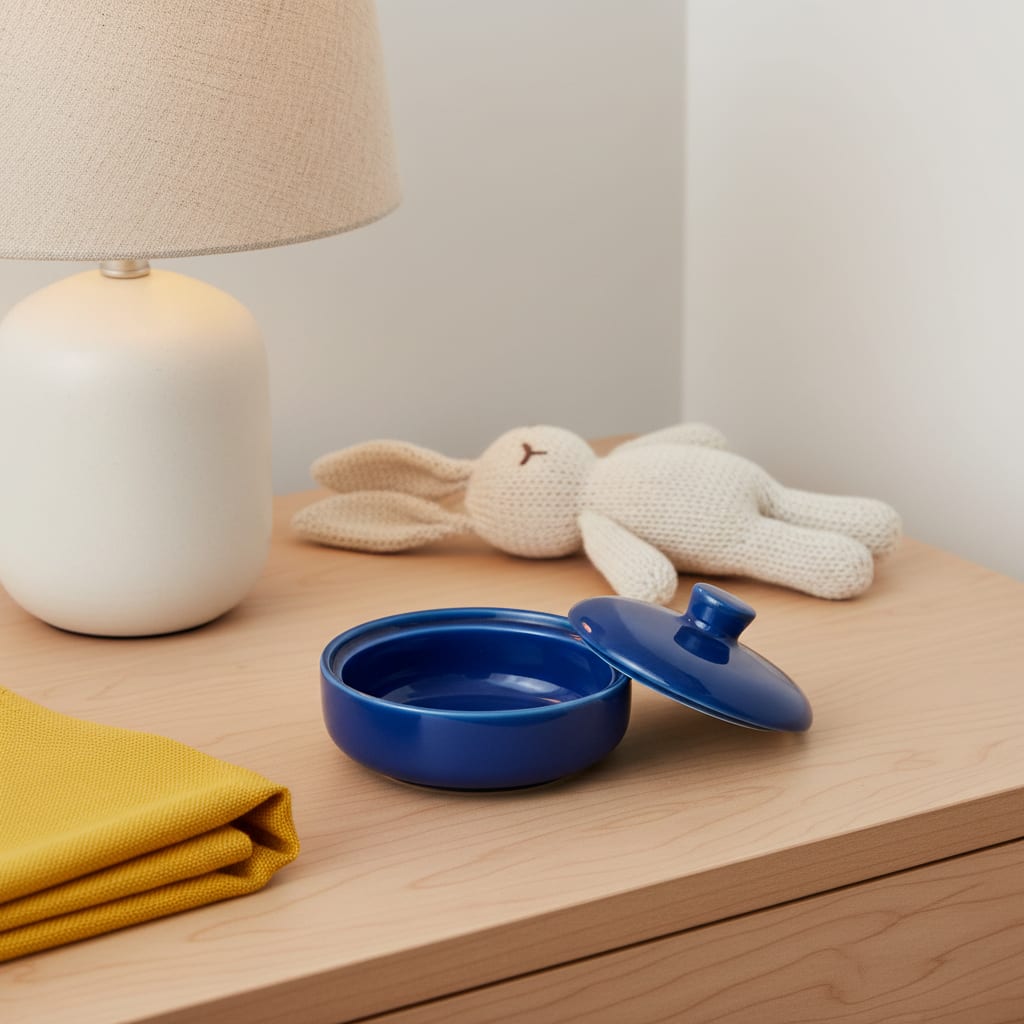
The National Deaf Children’s Society adds a safety point that matters most at exactly this age: while some older children keep aids on, younger children should never be left alone with their devices, because small parts and batteries are a choking hazard. Their suggestion is a designated spot — “a special box near your child’s bed” — so the equipment has a home the child can see.
Pediatric audiology aims at wear time across all waking hours — but sleep is not lost listening time. Anything device-specific, including whether an aid can stay in until your child falls asleep, is an audiologist question.
What the silence gap actually changes
Most of the toddler night-time toolkit is auditory, and nobody notices until it is gone. A hearing toddler who surfaces at midnight gets a drip of evidence that the world is intact: a car outside, a sibling turning over, and above all a parent’s voice arriving before the parent does. Between roughly twelve and thirty-six months a child is still building the capacity to hold an absent person in mind, and sound is how that evidence usually arrives.
Take the devices out and those channels close at once. The child is in the dark and out of contact, and the only way left to check that anyone is there is to get up and look. Much of what reads as night waking in a deaf toddler is that check being run.
There is a second effect that surprises parents. Hearing contributes to balance, so without auditory input a deaf child leans harder on visual and tactile cues — and those, as the NDCS points out, are exactly the cues a dark bedroom removes. A child who seems unsteady or clingy just after their aids come out may be managing a real wobble, not stalling.
Teaching the part that is hardest to explain
The idea a toddler has to absorb is abstract: the sound is off only while you are asleep, and it comes back in the morning. MED-EL’s advice is to say exactly that, every night, as part of the sequence rather than in response to protest.
Three things make it land faster at this age. Remove the devices at the same point every night — many families do it during the last story, so the quiet arrives while the child is still in company rather than at lights-out alone. Put them in the same visible box, in view of the bed. And where a child dislikes the quiet badly, the NDCS notes an alternative to raise with your audiologist: taking the aids off after the child is asleep.
A predictable bedtime routine does more work here than in a hearing household, because it is the only forecast the child has. The NDCS suggests a picture sequence — bath, story, kiss, bed — each image taken away as it is completed, which “can reduce the anxiety of it ‘suddenly’ being bedtime.”

Reaching a toddler who cannot hear you coming
Walk in quietly, speak softly, put a hand on the child: the wrong order when the child cannot hear the first two steps. From their side, a hand arrives out of nothing.
Reverse it. Light first — a hall light, a low lamp, the door opening onto a lit landing — so your arrival is visible before it is physical. Then touch, in the same place every time, slow and steady rather than a pat. Then your face, close and in the light, where a child learning to lipread or sign can use it.
The same logic runs the other way, and the NDCS is blunt: make sure they know when you are going to leave the room. A hearing toddler tracks a parent’s exit by sound; a deaf toddler who looks up at an empty doorway cannot tell how long ago it emptied. Be seen leaving, with the same gesture each time.
It is also why the classic false start — settling beautifully, then fully awake forty minutes later — can be louder in a deaf household. Betteroo’s explainer on what a false start at bedtime actually is covers the mechanism; the extra piece is that the child surfaces into total silence and cannot check whether anyone is nearby without standing up.
Building the room around vision and touch
A fixed, dim light beats a dark room. The NDCS notes that darkness can feel worrying for a child who relies on visual communication, and that a nightlight or hallway light left on helps. Keep it dim, warm and stationary — a colour-cycling light manufactures moving shadows, the same principle that governs a toddler’s fear of the dark.
A visual morning signal. A light that changes colour at a set time does for a deaf toddler what an ok-to-wake clock does for a hearing one — the rare device where the light half is the useful half. The Hatch Rest (now Hatch Baby) is the usual choice.
Be honest about white noise. For a child with no usable hearing once the devices are out, it does nothing after removal. It can still earn its place during the wind-down while aids are in — just do not build the settling routine on a cue that switches off when the devices do.
The alarms a sleeping child cannot hear
Families reach this one late. A smoke alarm is an auditory device, and for several hours every night the person it protects is not connected to sound. The US Fire Administration’s guidance: “If you are deaf or hard of hearing, use smoke alarms with a vibrating pad, flashing light or strobe light,” and “these accessories start when your alarm sounds.”
For a bedside version, a unit such as the Lifetone HLAC151 listens for a standard alarm’s pattern and answers with a bed shaker, a low tone and a flashing display. Such units respond to a specific alarm pattern rather than to every alarm sold, and many local fire departments run reduced-price or free programs.
When to check with your audiologist or pediatrician
Take anything device-specific to your audiologist: skin red or sore under a coil or mould, buzzing bad enough to stop a child settling, any change in how they respond when the equipment goes back on. Take ordinary toddler questions to your pediatrician — a sudden run of night waking that could be an ear infection, or separation anxiety escalating rather than easing. Nothing here is medical advice, and a general toddler sleep plan is no substitute for your child’s own team.
FAQ: toddler sleep with hearing aids and implants
Can my toddler sleep in their hearing aids?
Ask your audiologist — it depends on the device and the child. The general guidance is that ears benefit from a rest overnight, and that young children should not be left unsupervised with devices, given the choking risk from small parts and batteries.
Why does my deaf toddler settle fine and then wake forty minutes later?
That pattern is common in hearing toddlers too — a light-sleep surfacing rather than a full waking. What differs is what happens next: with no sound, the child cannot check that anyone is nearby without getting up. A dim light left on, or a door ajar onto a lit landing, often shortens it.
How do I wake or comfort a child who cannot hear me approach?
Light before touch, then touch before speech. Make your arrival visible, use slow steady contact in the same spot each time, and get your face into the light before you say or sign anything. Arriving hand-first out of the dark is startling.
See also: nearby entries
18 Month Sleep Regression: Signs, Causes & What to Do
July 17, 2026

Toddler Biting: Why It Happens & How to Stop It
August 3, 2026

New Medication and Toddler Sleep: What to Ask the Doctor
September 3, 2026