Toddler Fear of the Dark: Why It Starts and What Helps
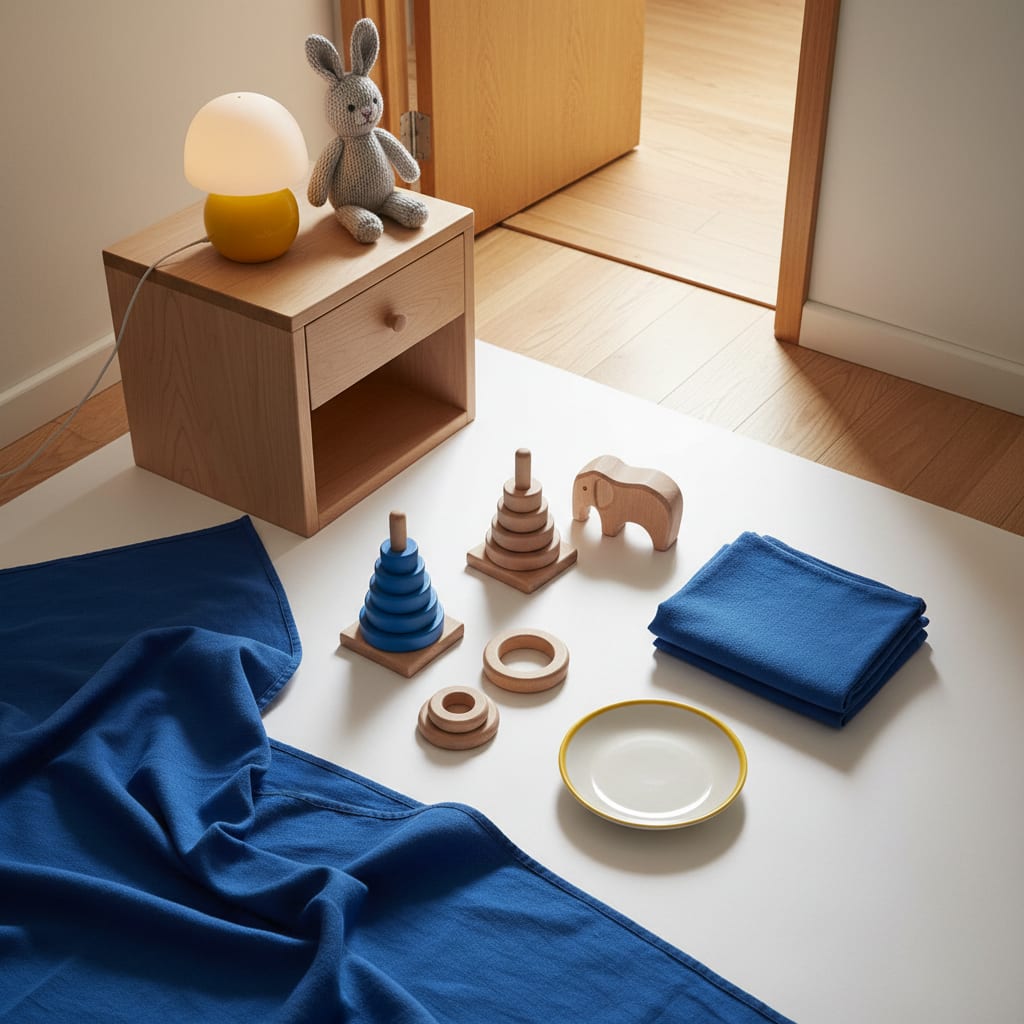
Fear of the dark is not a sleep problem that developed. It is a thinking skill that developed. It typically appears after the second birthday — commonly described as emerging between two and three — because that is when a child becomes properly capable of imagining something that is not in the room. Before that, a dark bedroom is a dark bedroom. Afterwards, it is a space a child can populate. That is why the fear arrives so suddenly in a toddler who has slept happily in the same room for a year.
What has to develop before the dark can be frightening
Two capacities have to be in place. The first is symbolic thought — the pretend play that takes off in the second and third years, where a block becomes a phone and a blanket a cave. The second is a fantasy–reality boundary still under construction: a two-and-a-half-year-old is fully engaged in a world of pretend and does not reliably know which parts of it are real.
Put those together in an unlit room and you have the mechanism. The imagination is now powerful enough to generate a figure in the corner, and the reality check that would dismiss it is not yet strong enough. The dragon from the bedtime story is not remembered as fiction; it is remembered as something that exists somewhere, and the corner of the room is somewhere.
Why it almost never appears before two
Parents often ask whether a fifteen-month-old can be scared of the dark. Almost always, no — a toddler that age protesting at lights-out is protesting the separation, the end of the day, or a boring room, all of which look identical from the doorway. Dark-related fears and nightmares under two are described as rare for the same reason: the equipment that manufactures them is not yet online.
The distinction matters because the responses diverge. Separation distress settles with predictability and a short goodbye. A genuine imaginative fear does not, because there is now a content to it.
Why bedtime is when it lands
Fear of the dark almost never shows up at four in the afternoon. It shows up at 7:15pm, because bedtime removes in one move everything that keeps an imagination occupied: the light, the company, the noise, any task to perform. What is left is a child alone in a dim room with nothing to think about and a brand-new ability to think about anything at all.
It is also worse after a stimulating day — a new film, an older cousin’s story, a busy afternoon. The raw material goes in during the day and gets processed in the only quiet hour available.
Fear or stalling? The difference matters
The two need opposite responses. A fear is served by making the room feel safer; bedtime stalling is served by the limit holding steady. Confusing them means either dismissing something real or negotiating with something that grows the more you negotiate.
| Signal | Reads more like fear | Reads more like stalling |
|---|---|---|
| The complaint | Specific and repeated — the same corner, the same thing | Varies nightly: water, potty, one more book |
| Body | Genuinely tense; scanning the room; won’t look away from a spot | Relaxed, chatty, cheerful between requests |
| Timing | Also happens on waking at 2am, alone | Almost exclusively while you are still in the room |
| Response to company | Calms immediately when someone is present | Escalates when the request is refused, not when alone |
| A dim light | Helps noticeably | Makes little difference either way |
Plenty of nights are both: a fear that gets a dramatic response can acquire a stalling function within a week. That is not manipulation, but a toddler learning what works.
Why reassurance backfires
The instinct is to prove the fear wrong: turn on the light, look under the bed, announce that monsters are not real. It rarely works, for two reasons. A search implies the possibility — an adult who checks under the bed nightly has demonstrated that under-the-bed is a category worth checking. And “there’s nothing there” asks a child to accept an abstract argument at the exact moment their capacity for abstraction is what caused the problem.
What works better is treating the feeling as real while leaving the content alone: acknowledge that the room feels different at night, then change something physical about it rather than debating what is in it. A predictable bedtime routine does much of this work by giving the last twenty minutes a shape with nothing frightening in it.
 Cross-reference
When the fear and the schedule are tangled
An overtired toddler is a more frightened toddler. Betteroo builds a plan from your child's real age, wake time and nap history so bedtime starts from the right place.
Take the 2-minute sleep quiz →
Cross-reference
When the fear and the schedule are tangled
An overtired toddler is a more frightened toddler. Betteroo builds a plan from your child's real age, wake time and nap history so bedtime starts from the right place.
Take the 2-minute sleep quiz →
Night lights, and what they are actually for
A night light is not a cure; it removes the blank canvas. The useful properties are dimness, warmth of colour and a fixed position — never moving or colour-cycling, since a shifting light generates the moving shadows you are trying to eliminate. A combined night light and sound machine such as the Hatch Rest (now sold as the Hatch Baby) is the common way families do this, since one device holds a low fixed glow all night and masks the household noises that supply half the material.
Two other physical fixes earn their place. Shadows have sources: a coat on a hook, a dressing gown on a door, a plant against a streetlight. Walk the room at your child’s height with the light at bedtime level and remove whatever resolves into a figure. And a door left ajar with a hall light beyond it often reassures more than anything inside the room, because it says the household is still there.
Monster spray divides opinion for a good reason
Against the popular fix — a bottle of water sold as monster repellent — spraying for monsters concedes that there are monsters, and it stops working the night your child works out what is in the bottle. In its favour: it hands a frightened child an action, and a toddler with something to do is in a stronger position than one told to stop worrying.
The compromise most families land on is a ritual that gives agency without endorsing the content — a torch within reach, a guard toy posted at the foot of the bed, a “goodnight” said to each object in the room. Same function, no claim about what lives under the bed.
Nightmares are a separate thing
A fear of the dark happens before sleep; a nightmare happens during it, in the second half of the night, and produces a child who wakes, remembers something and wants comfort. Both become more common in the same age band for the same underlying reason. Betteroo’s guide to dreaming and bad dreams in early childhood covers the distinction.
The third thing here is a night terror, which is not a fear at all — the child appears awake and terrified but is not conscious of you or the room, and remembers nothing. Betteroo’s explainer on what a night terror looks like from the doorway is worth reading before assuming a screaming episode is fear of the dark. If your toddler is also waking repeatedly at night or leaving the bed, those are separate entries.
When to talk to your pediatrician
Nighttime fear is developmentally ordinary. Raise it if it is escalating over months rather than easing; if it has spread into daytime avoidance or refusal to be alone in any room; if your child is losing substantial sleep night after night; if it began abruptly after a frightening experience; or if it comes with a change in mood, appetite or development. Nothing here is medical advice — it’s a well-organized head start for that conversation.
FAQ: toddler fear of the dark
Is it normal for a two-year-old to suddenly be scared of the dark?
Yes, and “suddenly” is the usual pattern. The imagination arrives quickly, and the first fears tend to arrive with it. A child who was fine in the same room last month is not going backwards.
Will a night light make the fear worse or create a habit?
Neither, in most cases. A dim, fixed, warm light is a reasonable permanent feature of a child’s room and does not have to be weaned. A bright light or a screen is the version that causes trouble.
How long does fear of the dark last?
There is no fixed duration. It often eases through the preschool years as the fantasy–reality boundary firms up, but nighttime fears are commonly described as continuing in some form well into school age. Expect it to change shape rather than end.
See also: nearby entries
Best Toddler Sleep Apps and Programs for 2026
October 15, 2026
The Toddler Hitting Phase: What's Normal, What Helps
August 3, 2026

2 Year Old Sleep Schedule: Naps, Meals & a Full Day
July 17, 2026