Toddler Bedtime Stalling: Why One More Never Ends
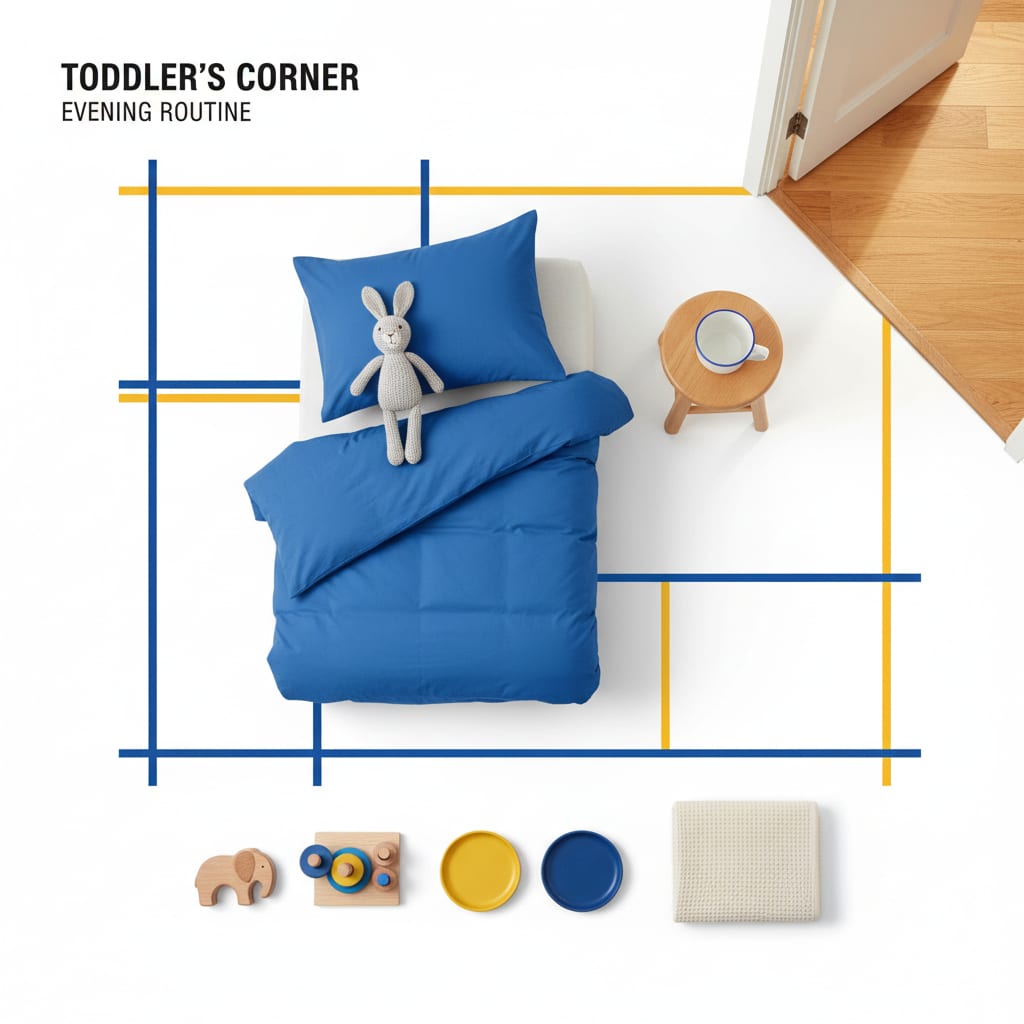
Bedtime stalling — the drink, the book, the toilet, the sudden urgent question, the cuddle that must be repeated — is not a bad habit a toddler picked up. It is a developmental stage, and it arrives only once a child has assembled four things they lacked a year earlier: enough language to make a specific request, enough memory to know what comes next, enough sense of self to want a say in it, and enough understanding of separation to want to postpone one. A fifteen-month-old cries at bedtime. A two-and-a-half-year-old negotiates, and that is an upgrade.
Stalling is a skill before it is a problem
Notice what a stall requires: knowing the routine well enough to predict the ending, identifying the moment before it as the last opportunity, inventing a request an adult is likely to grant, and delivering it on time. That is planning, run against a person who does not want it to succeed — which is why stalling appears at a fairly specific point rather than gradually. The equipment goes in over a few months and then, at once, the child can do it.
The four capacities that make it possible
Language good enough to be specific. The CDC places two-word combinations at twenty-four months and self-referring words — “I,” “me,” “we” — at thirty. A child who can say I want water has a tool a crying child does not, and “one more book” beats a protest because it is a request an adult can reasonably say yes to.
Anticipation. Stalling depends on knowing the sequence and where in it you are. The predictable bedtime routine that makes bedtime easier at one is the same structure a two-year-old uses to time their move. The routine is still worth having.
The autonomy drive. The second and third years are the peak of wanting a say, and bedtime is one of the last decisions still made entirely by someone else. The drive that powers two-year-old tantrums powers the negotiation too.
A grasp of separation. Bedtime is where the day ends, the people leave and the child is alone. A toddler who understands that has a reason to keep the door open, and “one more cuddle” is the most honest request on the list.
Why it usually starts around two and gets worse before it eases
The stage tends to open in the second half of the second year, sharpen through two and a half, and stay lively into the fourth. That trajectory tracks the four capacities above rather than sleep itself, which is the tell: sleep pressure and nap needs change in this window too, but gradually, while stalling shows up as a step.
It also worsens the moment a child moves out of a crib, since a bed removes the physical full stop. That is a different problem once the child is up and out — our entry on the toddler who won’t stay in bed covers the escalation.
A taxonomy of stalls
Not all stalling is the same thing, and it matters because only some of it is behaviour.
| The stall | What it sounds like | What it actually is |
|---|---|---|
| The request | Water, snack, toilet, one more book | A bid for time, using something hard to refuse |
| The relational stall | One more cuddle, stay a bit, lie with me | Separation, stated plainly |
| The fear stall | It’s too dark, something’s there | Often genuine after two — a different problem |
| The physiological stall | Chatter, bouncing, not remotely sleepy | Not enough sleep pressure yet |
| The negotiation | Two books, then three; counter-offers | Boundary-testing, which is developmental work |
The fear stall deserves separating out, because after about two it is frequently real: fear of the dark arrives with the imagination and needs the room made safer, not the limit held harder. The physiological stall is the other misread — a toddler who is genuinely not tired is not misbehaving, and the fix is in the day, not the doorway.
The specific request is not the point
Parents often try to pre-empt stalling by pre-supplying everything: the water is already there, the toilet trip is built in, three books have been read. It rarely works. The child does not want water; the child wants a transaction — a request made and granted, proving the ending is still negotiable. Remove the water and a new request appears within seconds.
That also explains why stalling resists being argued down. Each granted request confirms that requests work, and each refused-then-granted request confirms it more strongly, since a reward arriving unpredictably is the kind hardest to give up. A parent who holds firm for four requests and yields on the fifth has taught that the fifth is the one that works.
 Cross-reference
Check the day before you fight the doorway
Betteroo builds a plan from your child's real age, wake time and nap history — the fastest way to find out whether bedtime is simply landing too early.
Take the 2-minute sleep quiz →
Cross-reference
Check the day before you fight the doorway
Betteroo builds a plan from your child's real age, wake time and nap history — the fastest way to find out whether bedtime is simply landing too early.
Take the 2-minute sleep quiz →
Why a finite allowance works when a flat no doesn’t
The best-known response — a set number of tokens a child can spend on post-bedtime requests — is worth understanding rather than copying, because the mechanism explains the stage.
A flat refusal denies the autonomy drive entirely, which is the one thing guaranteed to make a two-year-old escalate. Unlimited granting satisfies it but moves the boundary every night. A finite allowance does what neither manages: it converts an infinite negotiation into a scarce resource the child controls. The adult decides how many requests; the child decides which, and when. The autonomy need is met inside a limit that has not moved.
That is the shape parenting research calls warm-but-firm — high responsiveness paired with a boundary that holds, the pattern in Betteroo’s explainer on the authoritative style.
The practical version — how to run a pass system, what to say at the door — is our sister site’s territory, and their bedtime stalling tips is where to go. This entry stops at why the stage exists.
When stalling is really a schedule problem
Before treating stalling as behaviour, rule out the simplest cause: a child who is not tired at bedtime will fill the time with something, and requests are the most available something. The signature is a toddler who is cheerful, chatty and bouncy at lights-out, takes a long time to fall asleep, then sleeps solidly.
The usual causes are a nap that ran late or long, a bedtime that stayed fixed while the wake window grew, or a nap on its way out — none of them fixable at the bedroom door. A stall that appears suddenly in a child who never stalled before is more often a drifted schedule than a changed personality.
What the stage is actually teaching
A child who negotiates bedtime is practising forward planning, the effect of language on other people, and where a limit actually is — none of which can be practised on something that does not matter. It ends gradually rather than on a particular night, usually in the fourth or fifth year.
When to talk to your pediatrician
Stalling itself is not a medical issue. Raise bedtime with your pediatrician if your toddler takes a very long time to fall asleep most nights despite an age-appropriate schedule; if the resistance comes with snoring, noisy breathing or restless legs; if your child seems genuinely distressed rather than delaying; if it appeared abruptly and has not settled; or if overall sleep is short enough to affect daytime mood, appetite or development. Bring a week of written times. Nothing here is medical advice — it’s a well-organized head start for that conversation.
FAQ: toddler bedtime stalling
At what age does bedtime stalling usually start?
Most often in the second half of the second year, becoming impressive around two and a half. Before about eighteen months, bedtime protest is usually distress or separation rather than deliberate delay, because the planning a stall needs is not yet in place.
Is stalling manipulative?
Not in the sense the word implies. A toddler making a request that has worked before is doing something rational with new equipment. No deception is involved — the request is usually sincere, it just also buys time.
Should I answer the requests or ignore them?
Both extremes tend to backfire, which is why the finite-allowance approach exists: a fixed, small number of granted requests keeps the response predictable, while an unpredictable mixture of yes and no is the pattern that entrenches stalling most strongly.
My toddler stalls for an hour. Is that normal?
Long stalls are common, but an hour is worth investigating. Check the schedule first — a late or long nap is the usual culprit — then check whether requests are being granted inconsistently.
See also: nearby entries

18 Month Old Fighting Sleep: Defiance or Regression?
July 23, 2026
Toddler Speech by Age: 12 Months to 3 Years
July 23, 2026
2 Year Old Not Talking: What to Check and Who to Call
October 11, 2026