Why Toddlers Throw Everything (Schemas, Explained)
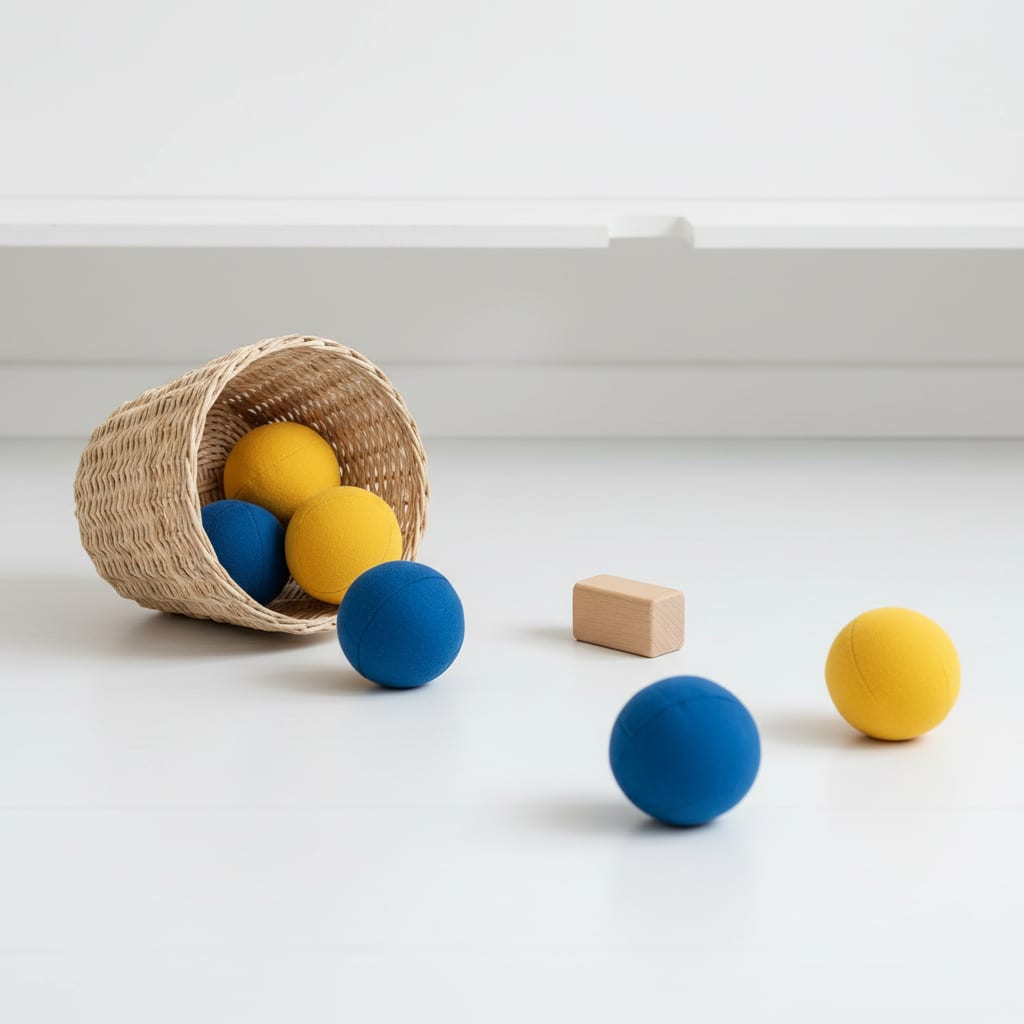
Most toddler throwing is not misbehavior — it is a repeated experiment about how things move. Early-childhood educators call the pattern a trajectory schema: a stretch of months in which a child is gripped by lines of movement, their own and everything else’s, and tests them over and over until the question is answered. Plenty of throws are that experiment. Others are frustration, fatigue, a missing word, or a very effective way to make an adult look up. They need different responses, which is why the first job is telling them apart.
What a schema actually is
In early-years language, a schema is a repeated pattern of behavior a child works through in order to understand one specific thing about the world. The idea grew out of Piaget’s work and was made usable in classrooms by the British researcher Chris Athey in the 1970s; the UK’s early-years framework still describes schemas as repeated patterns of behaviour, which is the useful phrase, because repetition is the whole point. A child in a schema isn’t doing the thing once to see what happens. They’re doing it forty times, in different rooms, with different objects, at different heights, because that is what it takes to be sure. From outside it looks like an obsession, or like a rule not sticking. From inside it’s a workload.
One honest caveat: schemas are a framework for reading behavior, not a developmental stage every child passes through on a timetable, and not something to be assessed or diagnosed. They explain the interest underneath a behavior — they never make a behavior safe or acceptable by themselves.
Trajectory: the pattern behind most throwing
The trajectory schema is a fascination with lines — vertical, horizontal, diagonal — and with what travels along them. It shows up in behaviors that look unrelated until you notice they’re the same question: food dropped from the high chair and watched all the way down, balls and remote controls thrown, a low shelf swept clear, water poured out of the bath and the cup and the sink, a corridor run full pelt, the bottom stair jumped off forty times, a running tap stared at far longer than seems reasonable.
The earliest version starts before toddlerhood: somewhere around nine to twelve months, a baby drops a spoon over the edge of a tray and watches. That is a genuine cause-and-effect experiment — objects fall, they make a noise, they still exist down there, and a grown-up reliably appears. By fifteen or eighteen months the same question comes back with arm strength, aim and an audience attached.
Sorting one throw from another
Not every thrown object means the same thing, and treating them all as one behavior is why “we’ve tried everything” is such a common sentence.
| The throw | What it looks like | What’s underneath | What answers it |
|---|---|---|---|
| The experiment | Calm, repetitive, unhurried; watches where it lands | Trajectory — a genuine question | A legal target, and lots of turns |
| The “I’m finished” | Plate or toy goes over the edge at the end of something | No usable way to say done | Teach and accept a signal; end the activity |
| The overload | Fast, hot, arrives with a shout or tears | A big feeling with no words attached | Handle it as a tantrum, not as throwing |
| The audience | Eye contact first, throw second, then a look at your face | Your reaction is the interesting part | Flat response, no chase, re-engage after |
| The aimed | Thrown at a person, usually in temper | Impulse arriving before the brakes | Stop it, few words, same handling as hitting |
Only the first row is really a throwing problem. The rest are a communication problem, a regulation problem, an attention pattern, or an impulse-control problem that happens to be using an object. The tantrum hub covers the machinery behind rows three and five — the aimed throw in particular is the same impulse story as hitting with a longer reach, and wants the same short, calm handling. Thrown food gets its own entry, because mealtimes have a setup that prevents most of it before behavior comes into it at all.
Other schemas that get read as naughtiness
Trajectory is the noisy one, but several others produce behavior families reasonably read as defiance. Transporting — carrying objects room to room, emptying every bag. Enveloping — wrapping, covering, posting things inside other things. Enclosing and positioning — lining things up, fitting them into containers, real upset when one is moved. Rotation — spinning wheels, taps, lids and themselves. Connecting — joining things together, and its inseparable twin, taking them apart.
Worth saying plainly, because it worries people: a toddler who lines up cars or spins wheels is doing ordinary toddler play. On its own, in a child who is otherwise sociable, communicating and progressing, it is not a finding of any kind.
Giving the trajectory somewhere to go
Blanket bans fail because the drive doesn’t switch off when the rule arrives. The formulation that works with toddlers is not don’t throw, it’s throw that, there, said the same way every time.
In practice: one or two designated throwables that live somewhere findable — soft balls, beanbags, rolled socks — and one designated target, whether that’s a laundry basket, a box or a bucket at the end of the garden. Then volume. A schema is satisfied by repetition, so ten minutes of deliberate throwing does far more than twenty corrections across a day. Our sister site’s activity ideas for one-year-olds and Betteroo’s round-up of things to do with a toddler both cover the what-to-set-up half.
Objects that must not be thrown are best handled by geography rather than rules at this age. A remote control on a high shelf teaches nothing, but it also doesn’t get thrown, and a fifteen-month-old is not yet holding a rule across a room and a distraction. That capacity arrives across the third year — which is why the instruction that fails at fifteen months starts working at thirty.
What makes throwing stickier than it needs to be
The reliable amplifiers are unglamorous. Large reactions — a gasp, a laugh, a chase across the room to retrieve the item — are all rewards, and the audience throw feeds on every one. Long stretches with nothing throwable available push the drive into whatever is to hand. And the end of the day, when tiredness and hunger stack up, manufactures throws that have nothing to do with curiosity at all. The single most useful diagnostic question is when: throwing spread evenly across the day is usually schema, and throwing concentrated in the hour before dinner is usually fatigue wearing a costume.
When to check with your pediatrician
Bring it up rather than wait if: throwing is aimed at people frequently and isn’t easing across months; the throwing arrives alongside a loss of words or skills; there is significant distress around ordinary sensory experiences at the same time; or your child isn’t using gestures and words to ask for things by the middle of the second year, which can leave throwing doing the talking. A parental sense that something is qualitatively different, rather than just hard, is also reason enough to ask.
This entry describes common patterns rather than your particular child, and none of it is a diagnosis.
FAQ: toddler throwing
At what age do toddlers stop throwing things?
There’s no fixed age. The experimental version typically thins out across the second half of the third year as the question gets answered and impulse control improves. Throwing that’s really about feelings or attention follows the arc of tantrums generally, easing through three and four.
Is it bad to let my toddler throw balls indoors?
No — a designated throwable and a designated target is the intervention, not a loophole in it. Children hold “throw that, there” far more successfully than “never throw,” because the second one asks them to switch off a drive rather than aim it.
Should I punish my toddler for throwing?
Consequences land poorly on a behavior the child doesn’t yet fully control, and they do nothing at all to a schema. Removing the object calmly, ending the activity, and offering the legal version elsewhere is more effective and much less work.
Why does my toddler throw things when they’re happy?
Excitement and frustration both raise arousal, and a body with more energy than control does what it knows. A cheerful throw is usually the experiment or the audience version, and it responds to redirection rather than a serious conversation.
See also: nearby entries

Autism and Toddler Sleep: Routines, Senses and Settling
October 11, 2026

Cough and Cold Medicine for Toddlers: What to Skip at Night
October 19, 2026
Toddler Chewing the Crib Rail: Molars, Covers and What Helps
October 15, 2026