Toddler Throwing Food: Why & How to End It
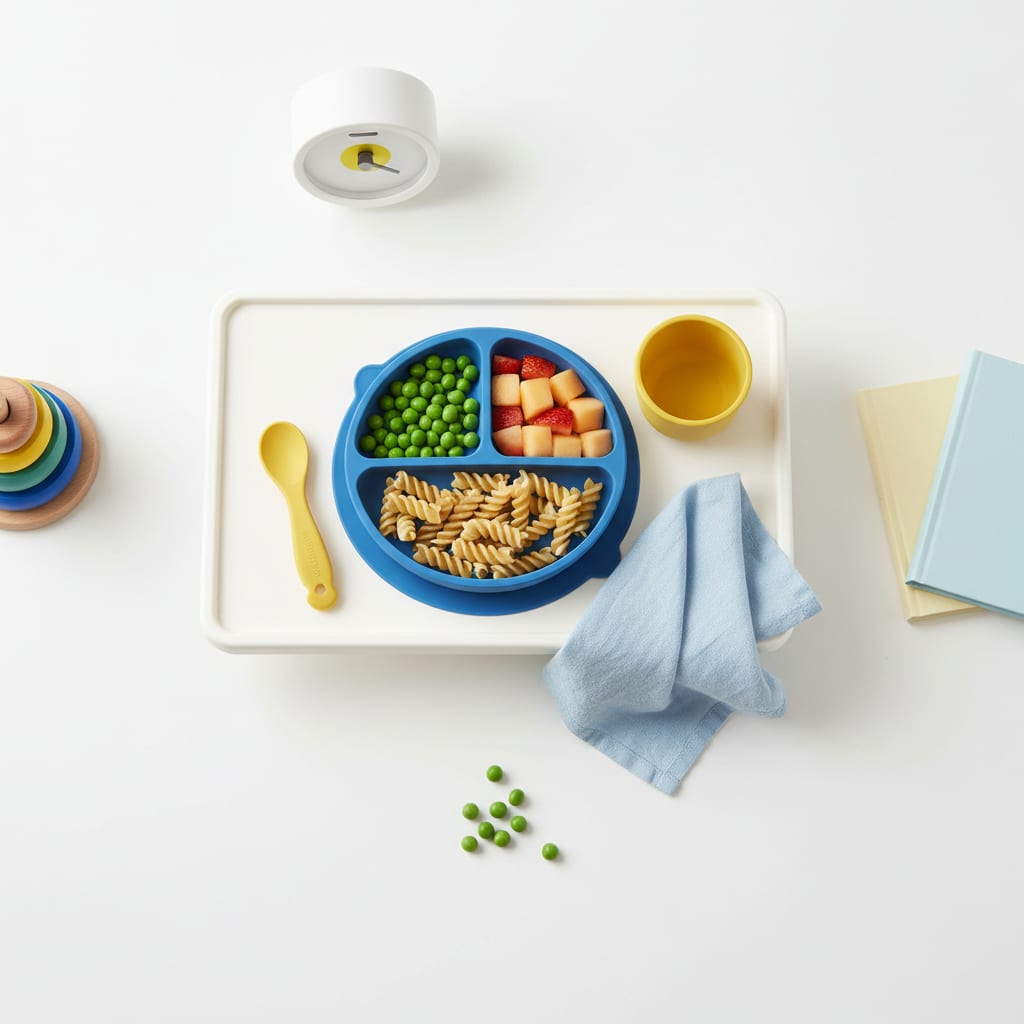
Toddlers throw food for three ordinary reasons: they’re done eating and have no other way to say so, they’re experimenting with what gravity does, or they’ve learned that a flying pea produces a genuinely excellent reaction. It is a normal phase, not a manners failure, and it almost always ends by around two and a half to three. The fix is structural rather than disciplinary — smaller portions, a clear way to signal “finished,” a flat unimpressed response, and ending the meal calmly when throwing starts. Here’s the full entry.
What the throwing usually means
- “I’m finished.” This is the most common one by a distance. A toddler who can’t yet say “all done” clears the tray instead. Plates get pushed, food goes over the side, and the message is exactly as simple as it looks.
- “What does this do?” Around twelve to eighteen months, dropping and throwing is a genuine research project — the schema of releasing an object and watching it fall is one of the things toddlers work through obsessively at this age. Yogurt behaves differently from a cracker, and that difference is interesting.
- “Look what happens.” Once a thrown grape has produced a gasp, a laugh, or a parent on their knees under the table, the behavior has a payoff attached. The food is no longer the point; the reaction is.
- “Too much is on this plate.” A loaded plate is overwhelming for a toddler and the excess frequently goes overboard — sometimes as a way of clearing space to eat what’s left.
- “I’m too tired to be here.” The late-afternoon meal takes the brunt of the day’s fatigue. If throwing happens at dinner and never at breakfast, that’s the answer, and the schedule is the lever rather than the plate.
The age arc
Twelve to eighteen months is peak experimentation: dropping from the high chair, testing textures, watching things land. Very little of it is aimed at you. Eighteen months to two is where communication takes over — the throwing now means “done,” “no,” or “I want down,” and it arrives with opinions. From about two, it becomes more social and more strategic: thrown food is a reliable way to get attention, end a meal, or protest the green thing. That’s also the age when the calm-and-boring response starts working quickly, because the child can connect the throw to the outcome.
The setup that prevents most of it
Meals are much easier to design than to police.
- Serve tiny portions. One or two spoonfuls at a time, with more available on request. A small amount on the plate removes both the overwhelm and the ammunition, and it costs nothing to refill.
- Give them a way to say “done.” Teach a sign, a word, or a gesture — hands up, “all done,” pushing the plate forward gently — and then honour it immediately the first fifty times. A toddler who has a working signal doesn’t need to throw one.
- Use a plate that doesn’t launch. A silicone mat-and-plate that suctions to the tray removes the easiest throw of all — the plate itself. The ezpz Happy Mat is the one I’ve seen survive the most toddlers; any one-piece suction mat does the same job.
- Sit them properly. Feet supported, tray at elbow height, upright. Dangling feet and a slouch shorten the time a toddler can stay engaged, and disengagement is when the throwing starts.
- Keep meals short. Fifteen to twenty minutes is a realistic toddler meal. Almost all throwing happens after a toddler is finished but still strapped in — end the meal at “done,” not at “plate empty.”
- Feed the pre-dinner slump. A substantial afternoon snack takes the desperation out of the 5:30 meal. Where that snack sits in the day is part of what the 18 month old schedule entry maps out.
The response that works
Flat, brief, identical every time — the same principle that ends hitting and biting.
- Say one short line, with no facial performance. “Food stays on the tray.” Not angry, not amused, not a lecture. Your face is the thing being tested.
- Block the second throw. Catch the hand or move the plate out of reach. Preventing is faster than responding.
- Ask the real question. “Are you all done?” If the answer is anything like yes, the meal is over — that’s not a reward, it’s an accurate reading of the message.
- End the meal after the second or third throw. Down from the chair, matter-of-factly, no scolding and no substitute snack ten minutes later. The natural consequence — the meal ends — is what does the teaching.
- Don’t run the retrieval game. Picking up thrown food repeatedly turns it into fetch. Clean up once, at the end, and where it’s age-appropriate let your toddler help.
Field note: the single fastest change I’ve seen at a family table wasn’t a consequence — it was cutting the portion by two-thirds. A plate with three bites on it doesn’t feel like a mountain to a toddler, and there is very little left to throw. Second helpings arrive on request, which also hands the child the control they were trying to take.
What not to do
Laughing (even once — it buys a fortnight of throwing), big dramatic reactions, long explanations mid-meal, and force-feeding or bargaining bites all make throwing more likely rather than less. So does replacing a refused meal with a preferred snack shortly afterwards: it teaches that throwing produces better food. Keeping the mealtime job description clear — you decide what and when, your toddler decides whether and how much — keeps you out of the fight altogether, which is the division of responsibility framing the picky-phase entry covers in full.
Drinks belong in the same conversation: a cup hurled off the tray is the same behavior as a thrown crust, and it responds to the same handling — offer, wait, remove calmly when it goes over the side. How much of that cup should be milk in the first place is a separate question, answered in how much milk should a toddler drink. And if the throwing coincides with a toddler who is otherwise happily self-feeding, Betteroo’s primer on baby-led weaning is a useful read on where the mess in this stage actually comes from.
When to check with your pediatrician
Throwing food is a behavior question, not usually a medical one. Mention it at a checkup if your toddler is throwing nearly all food and eating very little across weeks rather than days, if they gag, cough or seem to struggle with textures at meals, if weight or growth is a concern, if mealtimes have become distressing for your child rather than merely chaotic, or if the throwing is part of a wider pattern of behavior that worries you. This entry describes typical patterns — the person who can examine your child makes the calls about your child.
FAQ: toddler throwing food
Why does my toddler throw food when they’re not even angry?
Most of the time it’s either research (what happens when I let go?) or a “done” signal without words attached. Neither is defiance, and both fade as language and novelty wear off.
Should I make my toddler pick up thrown food?
From around two, inviting them to help clean up is reasonable, brief and matter-of-fact. Forcing it turns cleanup into a battle and, for younger toddlers, into a game. Don’t retrieve mid-meal — clean once at the end.
Is it okay to end the meal when my toddler throws food?
Yes — ending it calmly is the clearest, most consistent consequence available, and it matches the message the throwing is usually sending. Skip the follow-up snack, keep the next meal on schedule, and don’t attach a lecture to it.
At what age do toddlers stop throwing food?
Most stop somewhere between two and a half and three, once they can say “all done,” wait to be excused, and understand the outcome of throwing. Occasional relapses on tired days continue well past that and are normal.
My toddler only throws food at dinner. Why?
Almost always fatigue plus a long afternoon gap. Move the afternoon snack, bring dinner earlier, and shorten the meal — the same throwing usually disappears when the tank isn’t empty.
See also: nearby entries
15 Month Old Milestones: What Most Toddlers Do
July 31, 2026
The No-Nap Day: A Survival Plan for Everyone
July 27, 2026
18 Month Old Fighting Sleep: Defiance or Regression?
July 23, 2026