Potty Training Readiness: What's Actually Developing
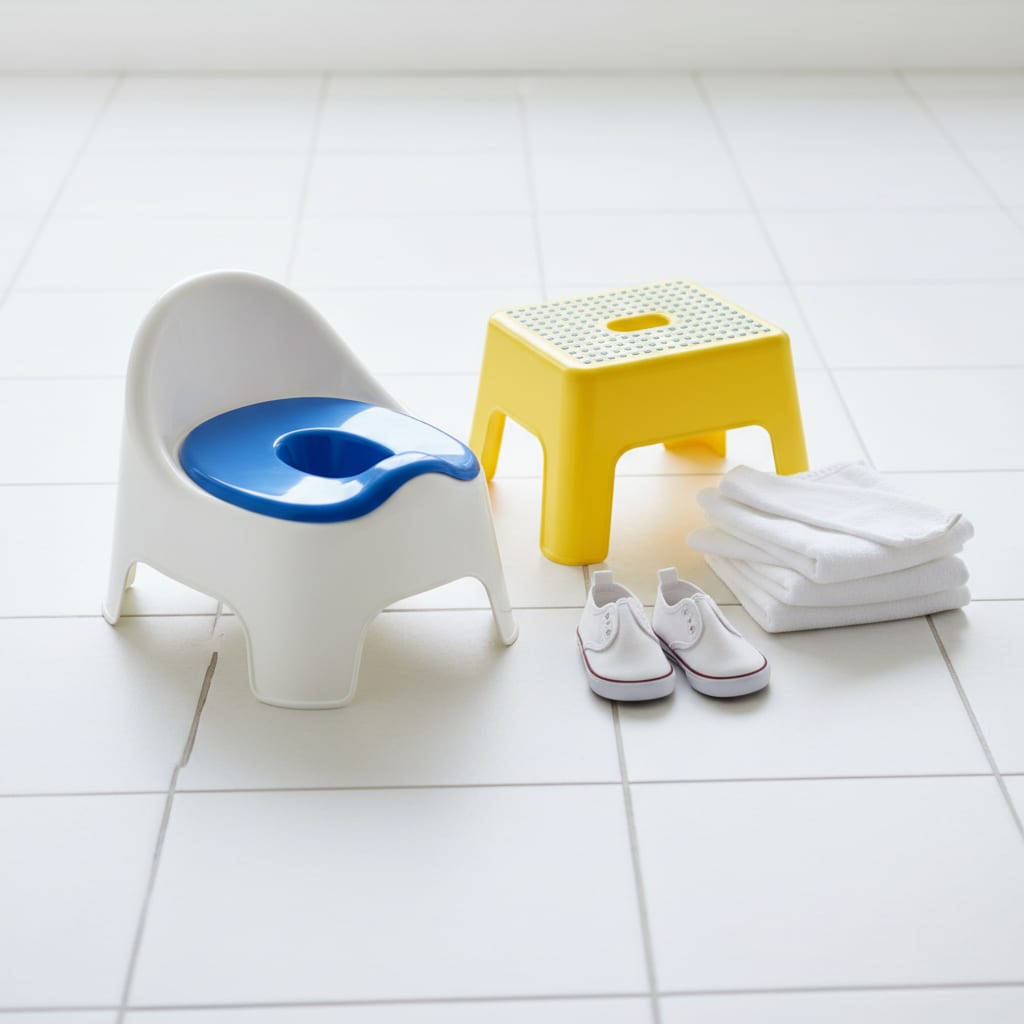
Potty training readiness is a developmental stage, not a parenting decision. Four separate systems have to arrive before a child can reliably use a toilet: bladder and bowel control mature enough to hold and release on purpose, the motor skills to get there and manage clothes, enough language to signal in advance, and enough self-regulation to interrupt something interesting for something boring. Those four rarely land together, which is why readiness commonly shows up anywhere from around eighteen months to past age three. This entry is about what is actually developing — not the how-to.
The four systems that have to converge
Physiological control. For most of the first two years, bladder emptying is largely a reflex. Somewhere in the second and third years, most children develop the awareness that the bladder is full and the ability to delay emptying for a while — first for minutes, later for longer. That maturation is not trainable; it either has happened or hasn’t. Longer dry stretches and larger, less frequent wettings are what it looks like from the outside.
Motor skill. Getting to the bathroom, sitting stably, staying on long enough, and pulling clothes down and up are four separate physical jobs. A child who can’t manage elastic-waist trousers alone depends on an adult being present at exactly the right moment — a slower and more error-prone system than it sounds.
Communication. The child needs some way to signal before rather than after — a word, a sign, a hand on the door. The reason “tells you after” is such a common first sign is that it shows the sensation has become noticeable; the gap between noticing after and noticing before is often a matter of weeks, and it tracks the same curve as toddler speech development generally.
Self-regulation. This is the one that decides the timeline for a lot of children. Using a toilet means stopping an absorbing activity, tolerating a small unpleasantness, and doing so voluntarily and repeatedly. That capacity is thin at two and noticeably thicker at three, and it develops on its own schedule regardless of how well the other three are running.
When readiness actually arrives
The honest answer is a range rather than an age. Readiness commonly appears somewhere between around two and three for many children, with a substantial number ready earlier and a substantial number later, and none of those positions predicting anything about the child. What is fairly consistent is the ORDER: physiological control and interest usually show first, communication next, and reliable self-regulation last — which is why so many families experience a stretch of “he obviously knows, he just doesn’t stop playing”.
Daytime and nighttime are separate developmental events, not two halves of one project. Night dryness depends on overnight urine production and on waking to a full bladder — both maturational, both frequently arriving a year or more after daytime dryness, and neither responsive to effort. Betteroo’s guide to why night dryness runs on its own clock covers that side, and our own entry on potty training and night sleep covers what the training week does to the nights.
Why the range is so wide
Wider than almost any other toddler milestone, and for four reasons worth separating.
- Nerve and muscle maturation genuinely varies. The same spread that puts first steps across a wide window applies here, with less to see from outside.
- Temperament weighs heavily. A cautious child, or a strongly autonomous one who resists anything suggested, can be physiologically ready months before they’re behaviourally willing.
- Environment sets the schedule as much as the child does. Group care with a bathroom routine, older siblings, warm weather and a family with spare time all pull the date earlier. A new baby, a house move, or a stretched adult pushes it later — sensibly.
- The definition of “trained” moves. Some families mean no accidents for a month; some mean using the toilet with reminders. Those are a season apart, and much of the apparent variation between children is variation between definitions.
Constipation deserves its own mention because it hides inside all four. A child who is uncomfortable passing stools will withhold, and withholding makes the whole project stall regardless of readiness. If pooing is painful, infrequent or being actively avoided, that’s a pediatrician conversation before it’s a training one.
What is still developing when readiness hasn’t arrived
If a child isn’t ready, something specific is usually still coming — and naming it is more useful than waiting vaguely.
Still soaking a nappy through every couple of hours points at physiological control. Noticing only afterwards points at interior awareness. Noticing in time but not saying anything points at communication. Saying it in time but not stopping what they’re doing points at self-regulation. Refusing the toilet outright while clearly capable usually points at autonomy — the same engine behind everything else a toddler is refusing that month — and it responds to pressure being removed rather than added.
Field note: in eleven years of classrooms I never once saw a later starter still in nappies at school. What I saw constantly was early starts stretching into six-month campaigns, and later starts finishing in a fortnight. Readiness isn’t a race you can win early; it’s a door that opens, and pushing on it before it does mostly costs you goodwill.
Interest is not the same as readiness
Interest is the easiest sign to spot and the least reliable one on its own. A toddler who follows you into the bathroom, wants to flush, and asks for underwear is telling you something real about curiosity, and nothing at all about bladder maturation. The reverse is also true and more frustrating: a child with all four systems in place who is bored by the whole subject is ready and unmotivated, which is a different problem with a different fix.
Sitting on a potty fully dressed, reading a book on it, and general familiarity cost nothing and can start whenever curiosity does — but that isn’t training and shouldn’t be scored as it.
Where the method half of this lives
This entry deliberately stops at development. For the practical side — the readiness checklist itself, what to buy, how to run the first days, and what to do about resistance and regressions — our sister site Best Toddler Tips keeps that lane, starting with their potty training readiness checklist. Read this entry to decide whether the door is open, and theirs to decide what to do about it.
Nothing here is medical advice. Raise it with your pediatrician if there is pain or straining, stools that are hard or infrequent, no daytime dryness signs by around three and a half, dribbling rather than proper voiding, or a loss of skills your child previously had — the eighteen-month, two-year and three-year visits all have a natural slot for the question.
FAQ: potty training readiness
What age is a toddler developmentally ready to potty train?
Most commonly somewhere between two and three, with a wide normal range on both sides. Age is a poor predictor on its own; the convergence of the four systems is the actual signal, and it doesn’t arrive on a birthday.
Can you train a toddler before they’re ready?
You can run the routine — many families do, and elimination-timing approaches start much earlier by design. What can’t be brought forward is the maturation itself, so early starts usually mean a longer project with more adult management rather than a faster finish.
Is it normal for a 3 year old not to be potty trained?
Yes. Plenty of typically developing three-year-olds are still in nappies, particularly if a sibling, a move or a nursery change has landed recently. It’s worth mentioning at the three-year visit for reassurance, not because it’s a red flag by itself.
Do boys become ready later than girls?
On average, boys are often reported as training slightly later, but the overlap between the two groups is enormous and the average tells you nothing about an individual child. Temperament and circumstances are far better predictors than sex.
My toddler knows when they need to go but won’t use the potty. Why?
That’s usually self-regulation or autonomy rather than a gap in ability — stopping an interesting activity is genuinely hard at two, and a child who has just discovered refusing will refuse this too. The pattern sits alongside the other developments listed in the 2 year old milestones entry, and it eases as self-control fills in.
See also: nearby entries

18 Month Sleep Regression: Signs, Causes & What to Do
July 17, 2026

Why Toddlers Throw Everything (Schemas, Explained)
August 11, 2026

When to Drop to One Nap: Signs & a One-Week Plan
July 19, 2026