Toddler Wakes When the Hall Light Goes Off: Why and What to Do
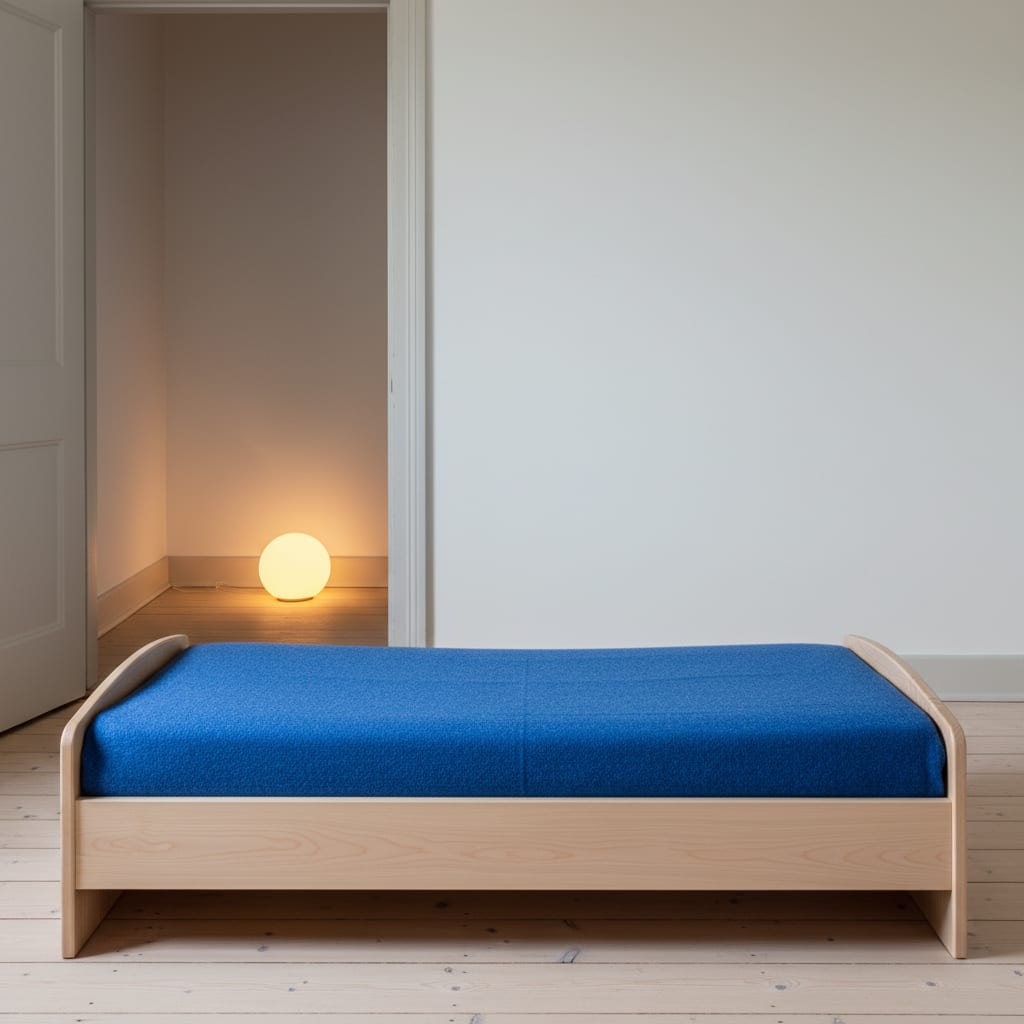
A toddler who falls asleep with the hall or landing light on and wakes soon after you switch it off is not usually waking because the room went dark. They are waking because it changed. Every sleeper surfaces briefly between sleep cycles, and a child who finds the room different from the one they fell asleep in tends to wake fully. The light has become part of how your toddler falls asleep. The fix is to make the light at 7pm match the light at 2am: either leave a dim, warm light on all night, or fade to dark before they fall asleep, never after.
How a light turns into a sleep association
Pediatric sleep medicine has a name for the wider pattern. The Society of Behavioral Sleep Medicine describes a sleep-onset association type of childhood insomnia in children who “need to be with a specific item or person to fall asleep or get back to sleep after awakening.” A light fits that description; it just never gets called one, because nobody chose it.
It usually arrives by accident: the landing light went on so nobody tripped, and a few weeks later it was simply how bedtime looked. Then you switch it off on your own way to bed.
Pediatric sleep physician Craig Canapari sets out the rule that makes this predictable: “If your child falls asleep under a set of circumstances that are not present during the night (being held, having their back rubbed, nursing, even having a pacifier in their mouth) they will need the same set of circumstances multiple times during the night.” His examples are about touch; a light is the same rule applied, not one of his cases.
The timing is part of the tell. At the end of every cycle, a sleeper comes up into a brief lighter state before drifting back down; Betteroo has a clear walk-through of how sleep cycles fit together. Canapari notes that with an association, “the first awakening typically occurs 2-3 hours after falling asleep.” For a toddler down at 7:30, that is the stretch of evening when many parents go up to bed and flick the landing switch on the way.
Is it the dark, or the change?
Fear of the dark is an imagination problem that needs the room to feel safe. A light association needs the room to stay the same.
| Signal | Points to the light changing | Points to fear of the dark |
|---|---|---|
| When it happens | First waking lines up with the switch going off | Often at bedtime too, while the light is still on |
| What they say | Nothing, or just crying | Names something: a corner, a shape, a monster |
| What settles them | The light going back on, fast | Your company more than the light |
| Age | Any age in the toddler years | Usually after two |
| Nights you forget the switch | They sleep through | Little difference |
The last row is the cleanest test: a toddler who sleeps through whenever someone forgets the switch is reacting to the change, not the dark.
What the light itself is doing
Young children are unusually sensitive to evening light. In a University of Colorado Boulder study of 36 children aged three to five, researchers found that “even in response to light measured at 5 to 40 lux, which is much dimmer than typical room light, melatonin fell an average of 78%.” The write-up adds that children’s eyes have “larger pupils and more transparent lenses than adults,” so more light gets in. Those children were older than most toddlers, and the light came before bed rather than overnight.
Colour matters too. A small follow-up from the same group (10 children, 3 to 5.9 years) gave each child 20 lux of evening light at two colour temperatures. Melatonin suppression averaged 56.3% under the cooler 5000K light against 23.9% under the warmer 2700K light. The authors call it “preliminary evidence.” Harvard Health puts the practical version plainly: “Use dim red lights for night lights. Red light is less likely to shift circadian rhythm and suppress melatonin.” Betteroo’s guide goes through why warm bulbs beat cool ones once the sun is down.
The CU Boulder write-up adds that this “does not necessarily mean that parents must throw away the nightlight.” It means that if a light stays, a dim warm one beats a bright cool landing bulb.
Route one: keep the light, make it constant
The simplest fix is to stop switching it off, and to change what is left on. Swap the landing ceiling light for a low plug-in light with a warm amber glow, such as the GE SleepLite amber night light, placed down the hall so your toddler sees its glow on the wall rather than the bulb. Leave it on from bedtime to morning, every night.
This keeps the sameness the association needs and drops the bright cool light. A dim, fixed, warm light does not have to be weaned.
Route two: fade to dark before sleep, not after
If you would rather your toddler slept in the dark, the rule is that every change has to happen before they fall asleep, so the room they drop off in is the room they will wake up in.
- Swap the source first. Change the bright landing light for a dim warm plug-in for about a week, with nothing else changing.
- Move it further away. Shift the plug-in down the hall, or to a room further along, so the glow at the door is fainter. Hold each step for several nights.
- Close the door gap in stages if the light comes through a door left ajar: a hand’s width, then a finger’s width.
- Turn it off before lights-out. The last step is a light that goes off as part of the bedtime routine, while your toddler is awake to see it.
Expect some protest at each step; it is shorter when a change is held than when it is undone at the first cry.
The one thing not to do is set a timer. The Sleep Foundation’s guide to light and sleep says, in advice aimed at adults, “a timer may also be helpful, allowing the light to turn off after you’ve fallen asleep.” For a toddler with a light association, that builds in exactly the change that causes the waking.

When it is not the light
If the wakings continue once the light is constant, the light was not the whole cause. The night-waking entry sorts the other usual suspects by age: schedule, regression, discomfort and other sleep-onset habits. At the other end of the night, summer dawn is the changing input; see early morning waking.
Mention it to your pediatrician if your toddler snores loudly or struggles to breathe in sleep, is waking for long stretches most nights despite a steady setup, or seems exhausted during the day. Nothing here is medical advice; it’s a well-organized head start for that conversation.
FAQ: toddler waking when the light goes off
Why does my toddler wake up when I turn off the hall light?
Most likely because the light is part of how they fall asleep. When they surface between sleep cycles and find the room darker than it was, the change wakes them fully. It usually is not fear.
Should I leave the hall light on all night?
You can, if you make it dim and warm. A low amber plug-in left on until morning is a reasonable permanent setup.
What colour night light is best for a toddler?
Warm: red, amber or orange tones, as dim as still does the job. In the small study above, a warmer 2700K light suppressed melatonin less than a cooler 5000K light at the same brightness.
How long does it take to fade the light?
Plan on a few nights per step and a couple of weeks overall. Going slowly beats reversing a step at 2am.
See also: nearby entries
18 Month Sleep Regression: Signs, Causes & What to Do
July 17, 2026

2 Year Old Tantrums: Why They Peak & What Helps
August 7, 2026

15 Month Sleep Regression: Why It Hits and What Helps
October 7, 2026