Development & Speech · Entry
21 Month Old Milestones: Talking, Climbing, Copying
The 21 month old milestones most toddlers are working on: more words and early phrases, body parts, books, copying adults, running, climbing and when to ask.
At twenty-one months, most toddlers walk, climb and are starting to run, understand simple requests without gestures, say a growing number of single words, and copy what the adults around them do. Many are beginning to point to body parts or pictures in a book when asked, and a few are putting two words together. There is no official checklist for this age. The CDC publishes milestone checklists at 18 months and 2 years, and twenty-one months sits right in the middle: the 18-month skills should be in place, and the 2-year skills are arriving one by one.
The halfway point between two checklists
The CDC lists are a screening floor. They name what most children do by that age, so a child who has only some of the 2-year items at twenty-one months is right on schedule. The two questions to ask this month are simple. Is the 18-month list essentially done? And is your child still adding new skills, month on month? A yes to both is what you’re looking for.
Language: the month words often pick up speed
The 18-month list asks for “three or more words besides ‘mama’ or ‘dada’.” The 2-year list asks for four language items:
- “Points to things in a book when you ask, like ‘Where is the bear?’”
- “Says at least two words together, like ‘More milk.’”
- “Points to at least two body parts when you ask him to show you”
- “Uses more gestures than just waving and pointing, like blowing a kiss or nodding yes”
At twenty-one months, a child is often partway through that list. Pointing to a picture when you name it usually comes before saying the word. Pointing to a nose or tummy on request often appears around now, especially if it has been a game. Two-word phrases are early at this age but not unusual, and some children produce a fixed phrase like “all gone” or “bye-bye car” before true combinations.
Books do a lot of work here. A lift-the-flap book such as Where’s Spot? gives you a natural “where is…?” question on every page, and the flap rewards a correct point with a surprise. Read the same one many times; repetition is how toddlers learn the words on each page.
The big variation in speech at this age is normal, and so is the frustration that comes with it. When a child knows what they want and cannot say it, the result is often a meltdown. Our 2 year old speech milestones entry covers what counts as a word, why home counts tend to run low, and the patterns worth raising with the pediatrician.
Copying: the main way toddlers learn
The 18-month list includes “Copies you doing chores, like sweeping with a broom.” By twenty-one months copying is everywhere. Your child wipes the table after you, stirs an empty bowl, holds a phone to their ear, and says words in your exact tone of voice.
This is worth leaning into. Give them a real cloth, a small brush or a spoon and bowl, and let them do the job alongside you. It is slower, but copying a real task teaches language, movement and patience in one go.
Movement: running, climbing and the first stairs
The 2-year list includes “Runs,” “Kicks a ball” and “Walks (not climbs) up a few stairs with or without help.” At twenty-one months:
- running is common, still a little stiff, with sudden stops
- kicking may happen if a ball is large and slow
- stairs are usually climbed on hands and knees, or walked up with a hand held
- climbing is constant, and getting down is now often easier than it was
The 2-year list also includes “Tries to use switches, knobs, or buttons on a toy.” Many twenty-one-month-olds have discovered light switches, door handles and the buttons on everything. That curiosity is a milestone and a safety issue at the same time.
Hands and meals
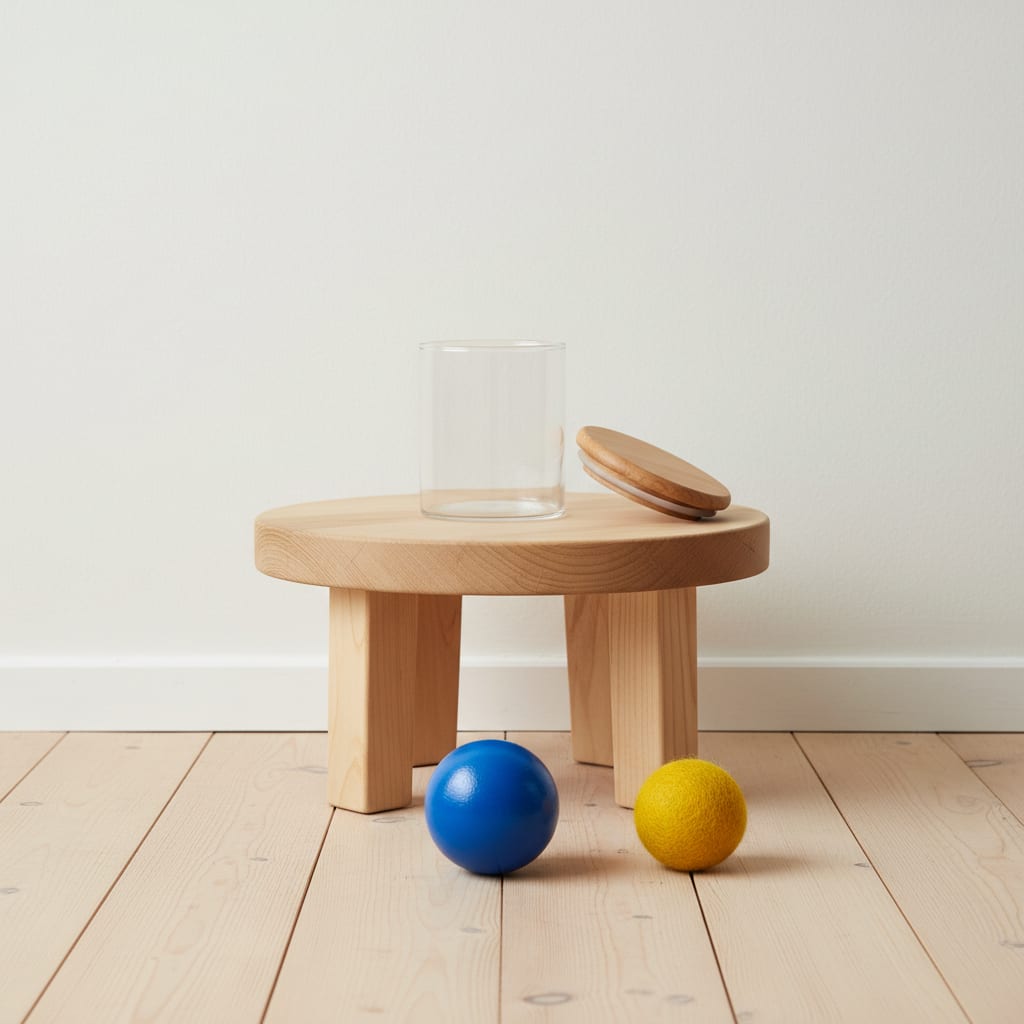
Twenty-one-month-olds can often hold something steady with one hand while working on it with the other, such as a cup while taking the lid off. That is an item on the CDC’s 2-year list. The spoon is improving but still messy; “Eats with a spoon” is also a 2-year item, so finger-feeding alongside it is fine.
Feelings: big ones, and the first signs of empathy
The 2-year list includes “Notices when others are hurt or upset, like pausing or looking sad when someone is crying.” Around twenty-one months you may see the beginnings of this: a toddler who goes quiet when another child cries, or brings you a toy when you look sad. It sits alongside plenty of grabbing and pushing. Both are normal, and toddlers do not yet understand sharing.
Field note: the toddler who brought a crying friend their own blanket was nearly always the same toddler who had snatched a toy from them ten minutes earlier. At this age kindness and grabbing live side by side. Name both calmly (“you gave her a blanket, that was kind”) and the kind part slowly grows.
Sleep at twenty-one months
New skills and frustration both show up at night. Most twenty-one-month-olds are on a single nap, and a nap that runs long can push bedtime late. The 21 month old schedule entry has a sample day and rules for capping the nap.
When to talk to your pediatrician
The CDC’s advice is the same on every checklist: “You know your child best. Don’t wait.” If your child “is not meeting one or more milestones, has lost skills he or she once had, or you have other concerns, act early.”
At twenty-one months, these are worth a call rather than a wait for the two-year visit:
- no words at all, or very few and not growing
- not pointing to ask for things or to show you
- not understanding simple requests
- not walking on their own
- losing words or skills they used to have
In the US, you can contact your state’s early intervention program directly; the CDC lists the numbers at cdc.gov/FindEI.
Where twenty-one months sits in the arc
The rung before this is 20 month old milestones, when running and pretend play often start. The next is 22 month old milestones, the run-up to the second birthday. For a second reading on what the birthday itself brings, Betteroo has a guide that looks ahead to that checkpoint.
Nothing here is medical advice or a screening tool. It is a well-organized head start for the conversation with your child’s doctor.
FAQ: 21 month old milestones
How many words should a 21 month old say?
The CDC’s 18-month list sets the floor at three or more words besides “mama” and “dada”. Most twenty-one-month-olds have more, with a wide normal range. No words at all is worth raising now.
Should a 21 month old say two words together?
Some do. “Says at least two words together” is on the CDC’s 2-year list, so it is not expected yet at twenty-one months.
Should a 21 month old know body parts?
Many can point to one or two when asked. “Points to at least two body parts” is a 2-year item, so it is still developing.
Why does my 21 month old copy everything I do?
Copying is how toddlers learn. The CDC’s 18-month list includes copying chores, and by twenty-one months copying covers words, tone and daily tasks.