Schedules by Age · Entry
23 Month Old Sleep Schedule: One Nap, Bedtime & Wake Windows
A realistic 23 month old sleep schedule: one nap, wake windows and a sample day, a bedtime-by-nap table, and what to leave alone before the second birthday.
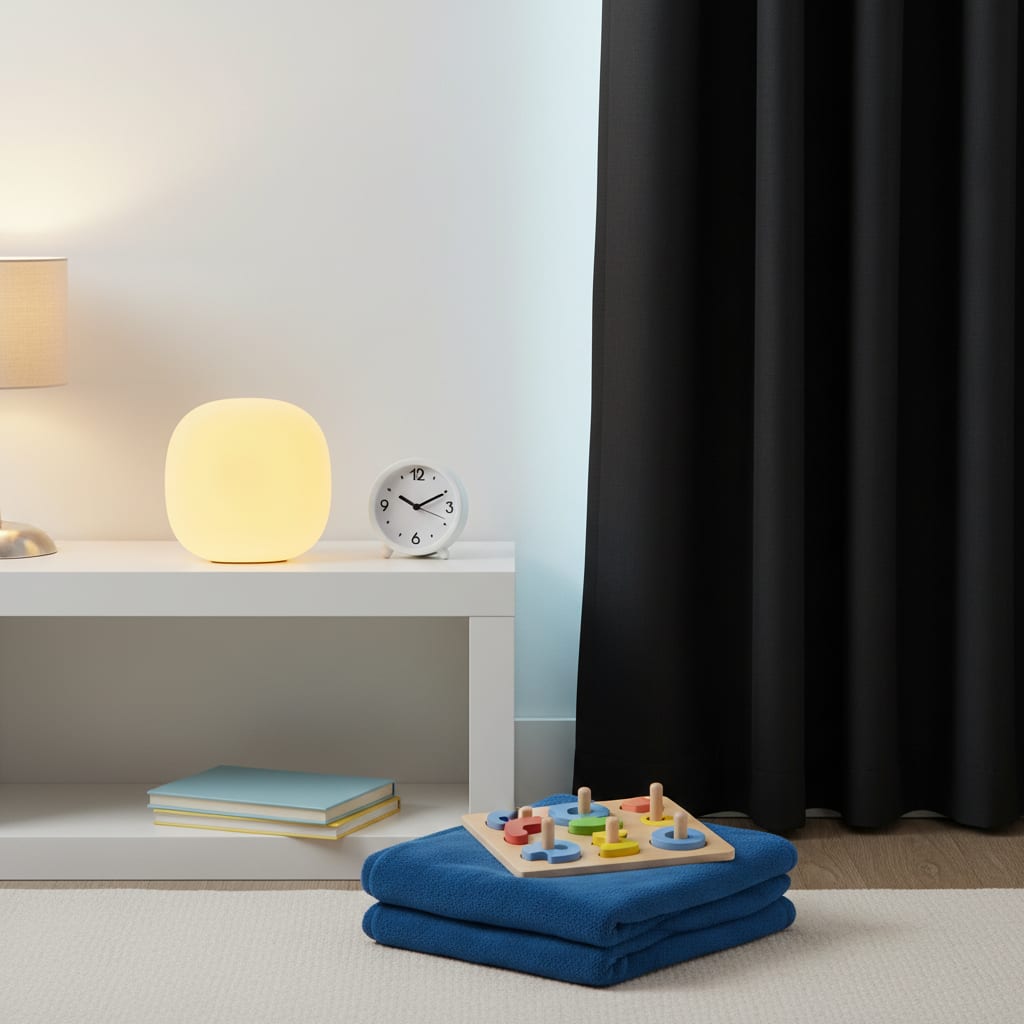
A typical 23 month old sleep schedule has one afternoon nap of about an hour and a half to two hours, a night of about eleven hours, and long awake stretches between them: wake around 7:00, nap from about 12:45 to 2:45, lights out between 7:30 and 8:00. The CDC’s range for one- to two-year-olds is “11–14 hours (including naps)” per 24 hours, and most toddlers this age land comfortably inside it. From 22 to 24 months the timetable is stable. The pressure at twenty-three months comes from the birthday ahead, which tempts parents into three changes that are usually better left for later.
A sample day at twenty-three months
| Time | Block |
|---|---|
| 7:00 | Wake + milk |
| 7:45 | Breakfast |
| 9:00 | Outside time |
| 10:15 | Snack |
| 10:45 | Play, errands or a class |
| 12:00 | Lunch |
| 12:30 | Wind-down: diaper, two books, dark room |
| 12:45–2:45 | Nap |
| 3:15 | Snack |
| 3:45 | Outside time or a walk |
| 5:30 | Dinner |
| 6:45 | Bath, pajamas, books |
| 7:30–8:00 | Lights out |
Anchor the grid to your child’s real wake time and keep the spacing. It is almost the same day as the 22 month old sleep schedule, and that is the point. Nothing about the twenty-third month calls for a new plan.
Wake windows at twenty-three months
| Typical at 23 months | |
|---|---|
| Awake before the nap | roughly 5½–6¼ hours |
| Nap length | roughly 1½–2 hours |
| Awake after the nap | roughly 5–5¾ hours |
| Night sleep | roughly 11–12 hours |
Treat these as common patterns. A child who falls asleep within about 15 to 20 minutes at both ends of the day is on windows that fit. If the nap now takes 40 minutes to start, move it 15 minutes later for three days before you change anything else.
Bedtime follows the nap
At this age the simplest way to set bedtime is to count forward from the end of the nap. The AAP’s sleep-hours page makes the same point about totals: the ranges “reflect total sleep hours in a 24-hour period,” so a child who still naps has that sleep counted too.
| Nap ended at | Lights out lands near |
|---|---|
| 2:00 (short or early nap) | 7:00–7:30 |
| 2:30 | 7:30–8:00 |
| 3:00 | 8:00–8:30 |
| No nap at all | 6:30–7:00 |
The table is just the afternoon window of five to five and three-quarter hours applied to the clock. Two notes on using it:
- Protect the last row. A day with no nap needs an early bedtime, not a normal one. An overtired toddler often takes longer to settle and wakes earlier the next morning.
- Don’t let the third row become the habit. A nap that regularly ends at 3:00 or later pushes bedtime toward 8:30. If that suits your household, fine. If it doesn’t, wake your child by 2:45.
Keep the nap dark even on bright afternoons so it starts on time. Blackout panels such as NICETOWN’s do the job at nap time and again on summer evenings.
Crib talk before sleep
Many toddlers close to two spend the first part of the nap or the night talking, singing or narrating the day to a stuffed animal. Language is growing fast at this age, and the crib is a quiet place to practice it.
- Leave happy chatter alone. A child who is content and stays lying down is resting. Going in usually restarts the clock.
- Time it before you act on it. Ten or fifteen minutes of talk is ordinary. Forty-five minutes every day for a week means the window before that sleep is too short.
- Judge by the afternoon. If the nap was mostly chatter and your child is cheerful until dinner, the rest did its job. If they fall apart at 4:30, bring bedtime forward that night.
 Cross-reference
A plan for the months either side of two
Betteroo builds a sleep plan for children from newborn to age 6 around your child's nap, bedtime and night waking, and updates it as the schedule shifts.
Take the free 3-minute quiz →
Three changes to leave alone before the birthday
The approach of two makes a lot of parents feel they should be moving on to the next stage. For sleep, the schedule at twenty-three months and the schedule at twenty-four are the same schedule. These three changes can wait.
- Moving out of the crib. A birthday is not a reason. A toddler who sleeps well in a crib and isn’t climbing out can stay there. The real reasons to move, and how to do it, are in our crib to toddler bed entry.
- Dropping the nap. A week of refused naps at this age is nearly always a phase or a timing problem. Keep offering the nap at the same time in a dark room. Most toddlers nap well past two.
- Pushing bedtime later because “they’re older.” Bedtime moves when the nap moves. If your child still falls asleep easily at 7:30, 7:30 is still right.
One change does sometimes arrive on its own just before the birthday: sudden bedtime protest, new night waking and nap refusal all at once, in a child whose schedule hasn’t changed. That cluster can be the early edge of the 2 year old sleep regression, which doesn’t wait for the exact date. Hold the schedule steady and read that entry before you redesign the day.
What changes at two
Very little. The full day at twenty-four months, with meals and play blocks, is in the 2 year old sleep schedule entry. The CDC’s range stays at 11 to 14 hours through age two and drops to “10–13 hours (including naps)” for three- to five-year-olds, so there is no step down in sleep need at the second birthday. Betteroo has a page on what the hours look like once the birthday passes.
When to check with your pediatrician
This entry describes typical patterns, not your child specifically. Talk to your pediatrician if your toddler snores or breathes noisily most nights, wakes often for weeks on end, seems tired all day despite enough time to sleep, or if sleep and daytime behavior have changed together. The two-year checkup is close, so start a week of notes on wake time, nap and bedtime now and bring them. None of this is medical advice.
FAQ: 23 month old sleep schedule
What is a good 23 month old sleep schedule?
One nap starting five and a half to six and a quarter hours after waking, and bedtime about five to five and three-quarter hours after the nap ends. From a 7:00 wake that means a nap around 12:45 to 2:45 and lights out between 7:30 and 8:00.
How much sleep does a 23 month old need?
The CDC’s range for ages one to two is 11 to 14 hours in 24, naps included. A common split is about eleven hours at night and one and a half to two hours in the day.
What time should a 23 month old go to bed?
Usually between 7:00 and 8:00, depending on when the nap ended. Go as early as 6:30 on a day with no nap.
Is my 23 month old ready to stop napping?
Very unlikely. Refused naps at this age usually pass within a couple of weeks if you keep offering the nap at the same time.
Should my 23 month old move to a toddler bed before turning two?
There is no need to. If the crib is working and your child isn’t climbing out, it can stay.