Crawling, Cruising and 2am: When Movement Breaks Sleep
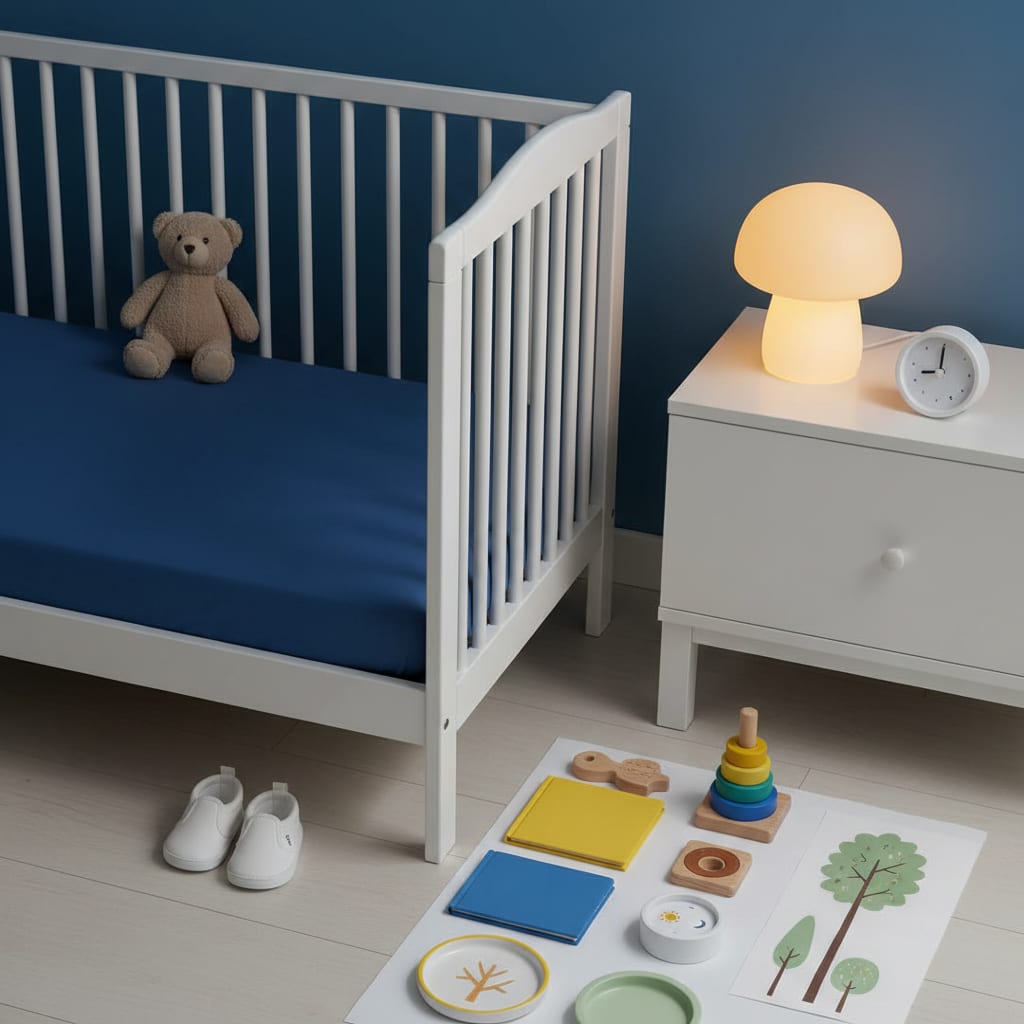
Somewhere between the first crawl and the first unaided steps, most families get a stretch of nights that makes no sense: a child who slept fine is suddenly awake in the dark, not crying, standing at the crib rail or rocking on all fours, apparently delighted. This is a motor-skill waking, and it has a reassuring explanation. A brand-new movement skill is not yet automatic, the drive to rehearse it is enormous, and rehearsal happens whenever there is spare capacity — including at 2am. It passes when the skill stops being new.
Why a new skill costs sleep
An adult learning something physical practises deliberately and then stops. A child at the start of a motor skill has no such switch: the skill is the most interesting thing in their world, and it is being consolidated rather than merely enjoyed.
Everyone wakes briefly several times a night at the boundaries between sleep cycles, and most of those wakings go unnoticed because there’s nothing to do. When a body has just acquired a thrilling new capability, there is now something to do, and the brief waking becomes a session. That is the whole mechanism, and it’s why the classic report is not a distressed child but a busy one.
It’s also why this window gets labelled a regression and mostly isn’t one. By the narrow definition we use — everything falling apart at once, for weeks, with nothing to point at — a skill burst is a different animal: specific, cheerful, and with a visible cause standing up in the crib.
The movement arc, and where the wake-ups land
The sequence matters more than the ages, and the ages are ranges rather than deadlines. The CDC’s checklists give the most commonly used US reference points:
| Skill | Commonly around | On the CDC checklist? |
|---|---|---|
| Sitting without support, getting into sitting alone | 9 months | Yes — a 9-month milestone |
| Crawling | Very variable; some children skip it | No — not listed at all |
| Pulling to stand, cruising along furniture | 12 months | Yes — a 1-year milestone |
| A few independent steps | 15 months | Yes |
| Walking without holding on | 18 months | Yes |
Two rows are worth pausing on. Crawling is not a CDC milestone — it was dropped in the 2022 revision, because the age range is enormous and a meaningful minority of children never crawl on hands and knees at all. “Should be crawling by nine months” is folk wisdom rather than a standard, which is why the disruption people call the nine-month regression turns up anywhere between about seven and eleven months.
The pull-to-stand row is the one that reliably breaks nights. Cruising demands the whole postural system at once, is practised with obsessive intensity, and lands in the same season as a spike in separation reactions — the CDC’s nine-month social list includes being clingy or fearful around strangers and reacting when you leave the room. A child who now both wants you specifically and can stand up to call for you is a different bedtime proposition than a month ago.
The stuck-standing problem
The most common version of the whole phenomenon: a child pulls to standing in the crib and cannot work out how to get back down. Standing up is one skill; lowering yourself is a separate one, learned later, and in between there is a period of being marooned. The wake-up starts as practice and becomes a genuine call for help, several times a night.
That gap closes in daylight, not at night. Practise the descent specifically — hands on the rail, one knee down, sitting — on the floor, a sofa edge, the crib rail before bed, as many times as your child will tolerate. Most families see the night calls fall away within days of the child being able to sit down alone.
Telling practice apart from something else
The mood test does most of the work. A skill-burst waking produces a happy, occupied, chatty child, with no distress unless they get stuck or bored. A child who wakes screaming, cannot be settled, or is off their food and unusually irritable in the daytime is telling you about something else — and the causes of night waking by age walks through the alternatives.
The other check is the timeline. Skill wakings arrive abruptly alongside a visible new ability, and improve as it becomes ordinary. A slow deterioration over weeks with no new trick to show for it is usually schedule drift.

Three things that shorten it
Rehearse the skill to boredom in daylight. The highest-value intervention by a distance. Floor time, and lots of it — crawling races, pulling up on low furniture, cruising the sofa, and above all the getting-back-down half of whatever they’ve just learned. The drive fades once the skill is automatic, and repetition while the sun is up is the fastest route there. Betteroo’s guide to how the walking sequence unfolds maps what to practise next, and its companion piece on crawling covers the stage before it.
Make the night response short and dull. Go in, lay them down without conversation, leave. No lights, no chat, no lifting out unless something is genuinely wrong. A newly mobile child finds an adult who arrives and does something interesting extremely motivating — that’s how a fortnight becomes a habit that outlives the milestone.
Hold the schedule where it was. Cutting the nap, pushing bedtime later or adding a feed back in treats a temporary disruption with a permanent change. Wake windows do lengthen across this stretch — adjust them because the daytime signals changed, not because of a bad week of nights.
One safety job belongs here too: as soon as a child can pull to standing, the crib mattress goes to its lowest setting. That’s a same-day task, and if standing is already turning into climbing, the safe next steps for a climber picks up where this entry stops.
What makes it drag on
Three patterns turn a two-week phase into a two-month one. Rescuing too enthusiastically — lifting out, feeding, bringing into your bed — solves tonight and creates an expectation. Restricting daytime movement to “save” energy backfires, because unpractised skills stay interesting longer. And treating a milestone as a discipline problem adds tension to something that resolves anyway.
If your child is still under a year, the baby-specific version of these nights sits with our sister site’s entry on a baby who has started fighting sleep; this site picks the story up at twelve months, where the pattern reappears in the regression that opens toddlerhood.
When to check with your pediatrician
Motor-skill wakings aren’t a medical matter, but the development around them can be. Raise it if your child isn’t sitting without support or bearing weight on their legs by around nine to ten months; isn’t pulling to stand or cruising by their first birthday; isn’t walking independently by around eighteen months; if movement is markedly one-sided; if muscle tone seems unusually floppy or stiff; or if a skill has been lost. Night waking with fever, ear-pulling, snoring or pauses in breathing is a separate and prompt conversation.
Ranges here describe what most children do, not a schedule to meet, and none of it is a diagnosis.
FAQ: skill bursts and night waking
How long does the crawling or cruising sleep disruption last?
Usually a couple of weeks, occasionally up to about a month while a big skill consolidates. Anything running longer has generally stopped being about the skill and become a habit built during it, or a schedule that drifted underneath.
My baby stands up in the crib all night and can’t get down. What do I do?
Teach the way down in the daytime, repeatedly — that skill is the missing piece. At night, lay them down calmly and leave without making it an event. The calls stop once the child can solve it themselves.
Is this the nine-month sleep regression?
It’s what that phrase usually describes, though “regression” is a poor fit — nothing has gone backwards. The window is wide because the skills underneath it have wide ranges, and separation anxiety commonly lands in the same season, which is why it feels like more than one thing.
My toddler learned to walk and now naps badly too. Related?
Very likely. Walking is the largest reorganization of the lot, and naps are lighter, more fragile sleep, so they show it first. Keep nap timing steady, keep the response boring, and expect it to settle as walking becomes ordinary.
See also: nearby entries
18 Month Sleep Regression: Signs, Causes & What to Do
July 17, 2026
Toddler at Your Bedside at 5am: The Silent Escape
August 23, 2026
Parallel Play: What It Is and When It Starts
October 15, 2026