The First Night in a Toddler Bed: What to Expect
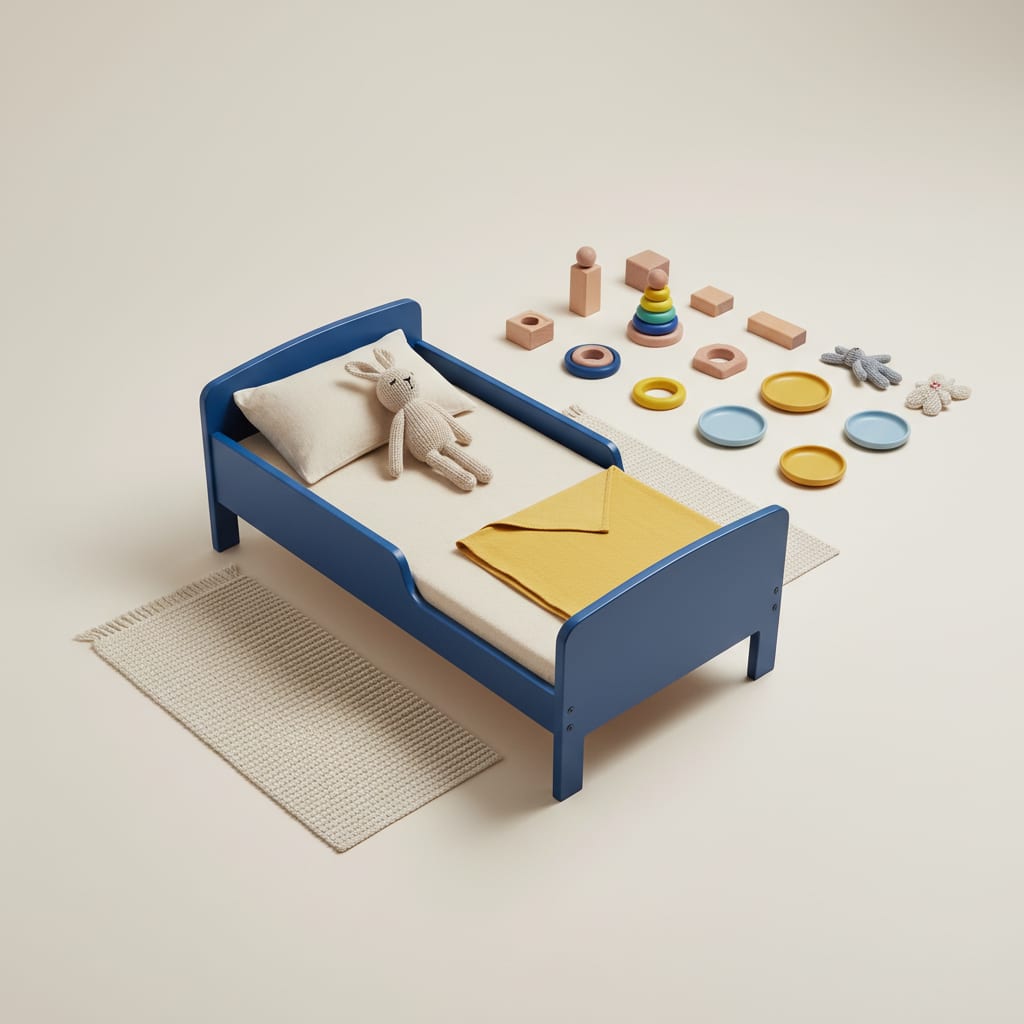
The first night in a toddler bed usually goes one of two ways, and neither one tells you much. Plenty of toddlers sleep straight through, because nothing about the room changed except a wall they slept through the removal of — they have not noticed yet. Others are up within ten minutes, delighted. Both are normal, and the night that actually decides how this goes is somewhere between night three and night ten, when the discovery lands and the new rule gets tested for the first time. Here is the entry on that first night and the fortnight after it.
What the side rail was actually doing
A crib rail is a boundary held by architecture. It asks nothing of your toddler: no memory, no impulse control, no cooperation. Once it comes off — and on a convertible crib it often comes off with two bolts, leaving the same mattress in the same corner of the same room — the boundary has to be held by something inside the child instead. A rule, remembered, retrieved at 2am, in the dark, half asleep, by a brain whose braking system is the last part to arrive.
Nothing about the bedroom got harder. The job got harder, and the job now belongs to your toddler.
Why night one predicts almost nothing
Two things make the first night a poor sample.
The honeymoon. A toddler carried to a lowered mattress after a normal bedtime has been handed a change they did not witness and may not register until they wake in the night or in the morning. A quiet first night is often just a delayed one, which is why families who declare victory on night one are so often the ones reporting a hallway parade on night five.
The false alarm. The mirror image is a toddler out of bed before you reach the stairs, five times, laughing. Novelty is doing the work, and novelty burns off. What is left after roughly a week is the real baseline.
The practical consequence: decide what you are doing before bedtime, run it unchanged for a week, then judge.
Reading the first night: five outcomes
| What happened | What it usually means | What to do next |
|---|---|---|
| Slept straight through, no idea anything changed | Discovery is pending, not avoided | Change nothing; expect a test night within the fortnight |
| Got out immediately at lights-out, cheerfully | Novelty, plus a boundary being checked | Walk them back, calmly and briefly, every time |
| Settled fine, then appeared at 2am | The rule was retrieved in daylight, not in the dark | Same response, same words, every waking |
| Found on the floor beside the bed | Rolled out — a fall risk, not a behavior problem | Fix the surface: rail, mattress height, floor |
| Cried at the door but did not leave the room | The rule landed; the separation did not | Treat as separation anxiety, not escape |
The middle three rows are the same problem wearing different hats, and they answer to the same boring consistency — the ordered playbook is in toddler won’t stay in bed.
Finish the room before you finish the crib
The commonest sequencing mistake is taking the side off on a Tuesday and planning to childproof at the weekend. From the moment that rail is off, your toddler can be loose in the room, awake, in the dark. The room has to be ready first.
Stanford Medicine Children’s Health lists 35 inches tall among the signs a child is ready to leave the crib, and advises that guardrails, if used, fit tight against the mattress and frame so there are no gaps. HealthyChildren.org, the AAP’s parent site, is blunt about the room: clear away furniture and large toys a child could fall against, stop dressers and other furniture tipping over, and consider a safety gate at the bedroom doorway and the top of the stairs. The full room-as-container setup is in toddler-proof bedroom for a climber.
One point worth stating plainly, because the guidance does: a guardrail exists to stop a sleeping child rolling out. It is not a restraint, and a plan that depends on it keeping a determined toddler in is the wrong plan.
Bedding, pillows and the floor beside the bed
A soft landing zone matters more on night one than anything you can buy: a rug, a folded duvet or the old crib mattress laid alongside the bed turns the likeliest first-night incident into a non-event.
Pillows are the other question that arrives with the bed. Flat, empty sleep surfaces are the safe-sleep rule in infancy, so this is genuinely the first point at which one belongs at all — and when it does, small and thin beats plush. Something like the Little Sleepy Head 13x18 toddler pillow is the shape to look for rather than a full-size pillow that props the head at an angle. For the timing, Betteroo has a sizing-and-timing guide worth a look.
Otherwise keep everything the same: same sheets, same comfort object, same bedtime routine in the same order. The bed is the only variable you want moving this week.
 Cross-reference
If bedtime was already fragile before the bed
A bed move on top of an off-schedule day is two problems at once. Betteroo builds a plan from your child's real age, wake time and nap history.
Take the 2-minute sleep quiz →
Cross-reference
If bedtime was already fragile before the bed
A bed move on top of an off-schedule day is two problems at once. Betteroo builds a plan from your child's real age, wake time and nap history.
Take the 2-minute sleep quiz →
The settling curve over the first fortnight
A typical arc runs: a quiet night or two, a discovery night, several nights of testing, then a fade. Some families get the testing first and the quiet after. Almost nobody gets a clean line in either direction, and expecting one is what makes week two feel like failure.
It helps to know the volume this can reach. HealthyChildren.org’s line on bedtime exits is that “twenty ‘farewell appearances’ in one evening is by no means an unusual number”, with the advice to return the child calmly each time and keep the interaction brief and boring so the appearance earns nothing. Twenty is not evidence the move was a mistake. It is the rate at which toddlers test things.
What bends the curve is the sameness of your response, including on the eleventh repetition. Our sister site besttoddlertips holds the hands-on half in its crib to toddler bed tips.
Putting the side back on is allowed
If the room is not safe enough, if nobody is sleeping after two weeks, or if the reason for the move has evaporated, the crib side can go back on. That is not a defeat and it does no lasting harm — a child who returns to a crib and stops fighting the boundary was telling you the boundary still did useful work. The thing to avoid is oscillating: put it back, run the crib for a month or two, and try again when there is a reason to. Timing, and why later usually beats earlier, is the subject of crib to toddler bed.
When to check with your pediatrician
Raise it if your toddler is losing substantial sleep night after night for several weeks with no sign of settling; if the waking comes with snoring, mouth breathing or pauses in breathing; if there is pain, distress or a change in mood, appetite or development alongside it; or if a fall from the bed caused an injury. Nothing here is medical advice — it’s a well-organized head start for that conversation.
FAQ: the first night in a toddler bed
My toddler slept perfectly the first night. Is that normal?
Very. It usually means the change has not registered rather than that it has been accepted. Keep the plan, keep the room safe, and expect a test night in the following week or two.
Should I sit in the room until they fall asleep on the first night?
Whatever you do on night one you will likely be doing for a while, because toddlers treat the first version of a new arrangement as the arrangement. Choose what you can repeat for a month, not what gets you through tonight.
What if they keep getting out and won’t go back?
Assume nothing is wrong for the first week and respond identically each time. If the parade is still running after two weeks of real consistency, look at the timing of the day rather than the bed. Betteroo’s guide to getting a toddler to sleep through the night is a useful second read on that.
Is a bed rail necessary?
Not for every child, but a reasonable default in the early months, particularly for a toddler who was a mobile sleeper in the crib. Fit it flush to the mattress and frame with no gap, and treat it as fall protection only.
See also: nearby entries
2 Year Old Not Talking: What to Check and Who to Call
October 11, 2026
When a Toddler Needs Less Sleep Than the Chart Says
August 3, 2026

19 Month Old Sleep Schedule: Naps, Meals & Bedtime
October 11, 2026