Toddler-Proof Bedroom: Contain a Climber Safely
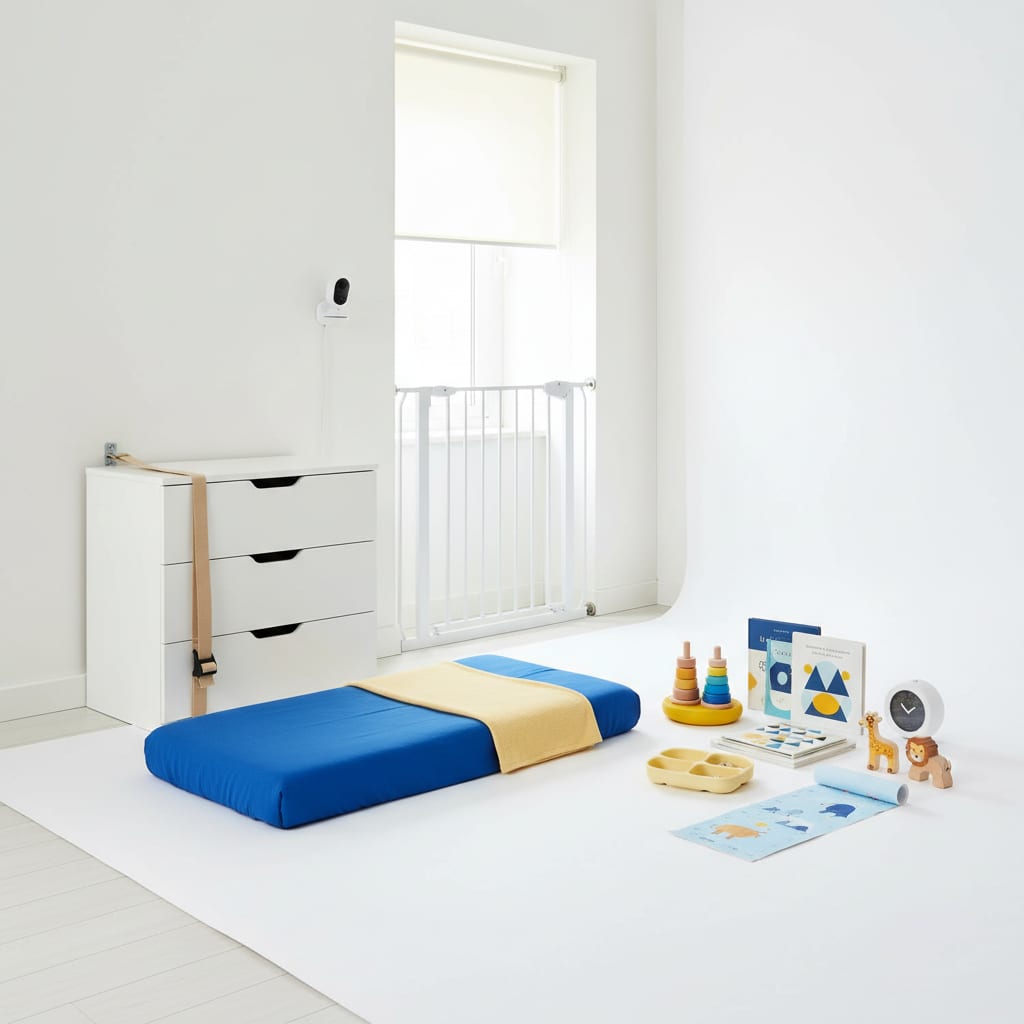
Once a toddler can reliably get out of the crib, the container becomes the room, and that only works if the room is safe to be alone in, awake, in the dark. The setup: mattress low or on the floor, every tall item anchored to a wall, windows guarded and blind cords eliminated, small objects and cords removed, a hardware-mounted gate at the doorway rather than a locked door, and a monitor so you can see what’s happening. What never belongs in the plan: crib tents, netting, improvised crib lids, or any door hardware that locks a child in.
Why the room, and not the crib
A climber who has beaten a lowered mattress and an emptied crib has ended the argument. Escalating from there, by adding height, a cover or anything that turns the crib into an enclosure, trades a fall risk for an entrapment risk, which is a worse trade. The tonight’s-checklist version of the climbing problem covers the fixes that keep the crib going longer; this entry is for after they stop working.
Your toddler is going to be loose in that room, awake, at some point tonight. The worst realistic outcome of an unsupervised hour there should be a mess.
The safe containment layer
Get the sleep surface low. Toddler bed, crib mattress on the floor or twin mattress on the floor: the fall distance should be a few inches. A floor mattress is a legitimate interim step, and often the least dramatic one, since the surface doesn’t change. If you’re moving to a bed properly, timing and set-up are covered in the crib to toddler bed transition, and Betteroo’s guide on how to know the bed move is due is a good second opinion on readiness.
Anchor everything tall. The highest-consequence item on the page, and the one most often skipped. Dressers, bookcases, changing tables, shelves and TVs all get strapped to a wall stud — a set of furniture wall straps costs less than a takeout dinner and takes about ten minutes per piece. A newly liberated toddler will climb the dresser. Drawer locks are a useful addition, because a stack of open drawers is a staircase.
Deal with windows and cords. Move the bed and any climbable furniture away from windows. Add window guards or stops so a window can’t open far enough for a child to get through, and replace corded blinds with cordless ones — a looped blind cord is a strangulation hazard, and winding it up out of reach does not stop a climber. Lamp, monitor, humidifier and charger cords get routed behind furniture or removed.
Strip the small and the sharp. Anything that could be swallowed, anything with a button battery, anything breakable, anything with a strap or a long cord. Assume the room will be explored thoroughly in the dark.
Get the door right. Never lock a child in a bedroom: it’s an entrapment and fire risk, and the one line not to cross when you’re tired and out of options. What is safe: a hardware-mounted gate at the bedroom doorway, which makes the room the safe zone while the stairs, bathroom and kitchen stay out of reach. A tall walk-through model like the Regalo Easy Step Extra Tall gate survives a climber better than a short pressure-mounted one, and hardware-mounting matters more than the brand. Add a soft door stopper or a pinch guard so fingers stay out of the hinge, and put knob covers on the doors you don’t want opened.
Watch instead of restrain. A video monitor turns “no idea what’s happening in there” into information. A non-WiFi model such as the Infant Optics DXR-8 PRO is the low-fuss choice if you’d rather not put a camera on the internet. Keep the camera and its cord mounted well out of reach.
What never goes in the plan
| Don’t use | Why |
|---|---|
| Crib tents, nets and canopy covers | Entrapment and strangulation risk; they solve a fall risk by creating a worse one |
| DIY crib lids, boards or bungeed covers | Untested, unsecured, and failure mode is a trapped child |
| Locks, chains or reversed doorknobs on the bedroom door | Entrapment and fire risk — a gate does the same job safely |
| Sleep sacks used to restrict movement in a bed | Sacks are for crib-phase climbing prevention, not for limiting a walking toddler |
| Ties, harnesses or anything that restrains a sleeping child | Never appropriate, in any configuration |
| A crib with the side removed or lowered improvisationally | Alters a tested product; use a purpose-built toddler bed or the mattress on the floor |
The general rule: if a containment idea requires modifying equipment or improvising hardware, you’ve moved from safety into engineering, and that is where the injuries come from.
Bedding in the new setup
Moving out of the crib usually raises the pillow-and-duvet question. Standard safe-sleep guidance keeps soft bedding out of the sleep space in the first year; for toddlers past that point, a small pillow and a lightweight blanket are typically fine, and it’s worth reading the age at which bedding becomes appropriate before you make the change. Keep it minimal: one thin blanket, one small pillow, no heavy comforters, no weighted blankets for toddlers, and nothing large enough to be dragged over to a dresser and used as a step.
The first week, in order
Do the safety work before the first night, not after the first incident. A workable sequence:
- Audit at toddler eye level. Sit on the floor in the middle of the room. Everything reachable from there is in scope, including the charger, the loose drawer knob and the shelf you walk past daily without seeing.
- Anchor and strip on the same afternoon. Everything in the containment layer above, done in one go; splitting it across a week is how the dresser stays unanchored.
- Reduce the toy inventory hard. Leave books and one quiet basket. Everything else moves out for a fortnight.
- Fit the gate and rehearse in daylight. Show your toddler the gate, the bed and the routine while the sun is up: “you sleep here, and when the light comes on you call me.”
- Set the monitor angle before bedtime. Point it at the bed and the door, so you can tell a child asleep on the floor from a child at the gate.
- Then hold the plan for a week. Expect two or three lively nights. Changing the setup on night two teaches your toddler it is negotiable.
Field note: what finally settles most newly liberated toddlers isn’t the gate, it’s the boredom of a properly stripped room. When there is nothing to do out of bed, getting out of bed loses most of its appeal within about a week.
Then handle the behavior part
A safe room stops the emergency; it doesn’t stop the door appearances. That part is a routine problem (a predictable wind-down, a clear boundary and the same flat return every time), and the playbook is in toddler won’t stay in bed. Two things speed it up: get the timing right, because a toddler with an hour of unspent energy will spend it on you, and stay dull.
If the timing is the piece you’re least sure about, the Betteroo sleep quiz builds a nap-and-bedtime plan around your toddler’s real schedule.
When to check with your pediatrician
Any fall with a head impact, loss of consciousness, vomiting, unusual drowsiness or behavior that worries you is a same-day call, not a next-visit mention. Beyond injuries, bring up relentless nighttime escaping that comes with very low total sleep, daytime exhaustion, or snoring and noisy or paused breathing at night.
FAQ: toddler-proofing a bedroom for a climber
Is it safe to lock my toddler in their bedroom at night?
No. Locking a bedroom door creates entrapment and fire risk. Use a hardware-mounted gate across the doorway instead; stairs and bathrooms stay out of reach, and adults can still get in.
Are crib tents or crib covers ever okay?
No. Tents, nets and improvised lids introduce entrapment and strangulation hazards worse than the climbing. If the crib needs a roof to hold your toddler, the crib phase is finished.
Can I just put the mattress on the floor?
Yes, it’s a common interim step that keeps the familiar surface and removes the fall height. Toddler-proof the whole room first, since a floor bed means unrestricted access to it.
See also: nearby entries

Toddler Stuttering: What's Normal and When to Worry
October 11, 2026
Toddler Speech by Age: 12 Months to 3 Years
July 23, 2026
Toddler Won't Eat Dinner? The Picky Phase, Explained
July 23, 2026