Toddler at Your Bedside at 5am: The Silent Escape
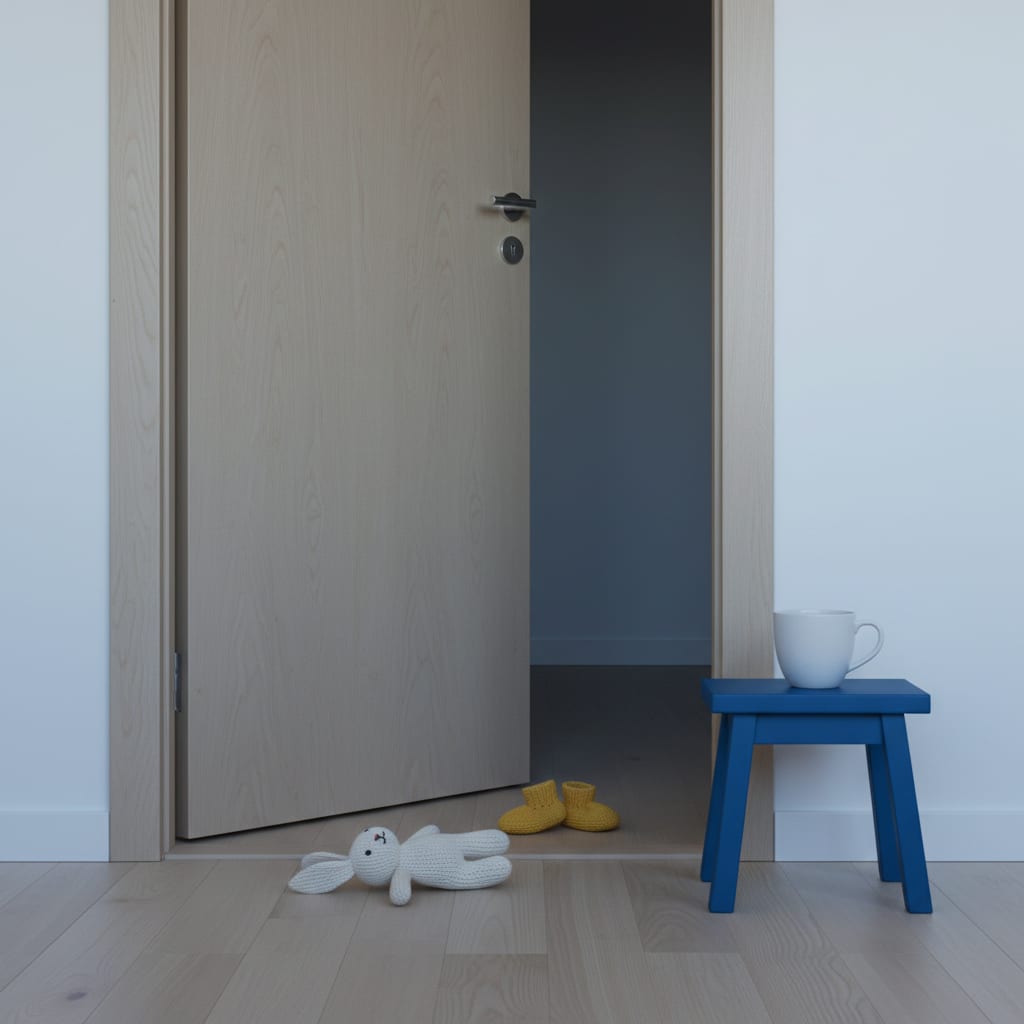
A toddler who gets out before dawn and turns up silently beside your bed has done three things you did not witness: left the crib or bed, crossed a dark room, and travelled the house. The arrival is the only part you saw. Before changing anything, recover the two facts you are missing — how they got out, and how long they had been awake — because a 4:40am wake and a 5:55am wake call for opposite responses. Tonight, make the exit audible and the route safe. Diagnose in daylight. Here is the entry.
The three things you did not see
Every other toddler sleep problem announces itself. This is the one that does not, and its upstream has three parts: the exit tells you what the container is worth now, the room crossing tells you your toddler moves confidently in the dark, and the journey tells you a door and a hallway were passable. Parents file it under waking — the child woke, so fix the waking — but you are working from a single data point taken at the end of the sequence.
If the exit was from a crib, the fall risk is the headline and a separate decision from the sleep one. The containment checklist, and the point at which the arms race becomes less safe than moving to a bed, live in the toddler climbing out of the crib entry — start there tonight, then come back.
Why the exit is silent when a cry is not
Crying is addressed to somebody. It is a signal that needs a receiver, and for the first year or so it is a child’s only way of changing their circumstances at 5am. Walking to you is not a signal at all — it is self-service. The child stopped reporting the problem and solved it.
That switch, from signalling to locomotion, is the actual development, and it is why you stopped being woken by a sound and started being woken by a presence. Nothing got worse; the toolkit got bigger. It also explains the quiet — there is no distress in the trip, so there is nothing to be loud about.
The timing is not a coincidence either. The last stretch of the night is dominated by light sleep, and sleep pressure — the drive that made 7:30pm easy — is nearly spent by then; Betteroo’s guide on the 4-to-6am problem walks through the physiology. A 1am waking is a half-asleep child who cries because that is all a half-asleep child can do. A 5am waking is often a complete one, awake enough to form an intention and carry it out.
The interval nobody measured
You do not know whether the trip took ninety seconds or fifty minutes, and that gap matters twice.
Diagnostically, it decides which problem you have. A wake at 5:50 after eleven hours is early rising, and the levers are schedule math, light and a boring pre-6am response — all in the toddler waking too early entry. A wake at 4:20 followed by forty minutes awake is a night waking that ended at your bedside, and belongs with the night-waking causes by age. Same arrival, opposite fixes. For safety, the interval is the window in which a toddler was awake, unsupervised and mobile in a house set up for a supervised one.
So instrument it before you theorise about it. A camera already in the room usually keeps a timestamped recording, which ends the argument. Failing that, make the door audible: a magnetic door alarm — the UltraPro (formerly GE) personal security window and door alarm is the common one — has a three-way switch, and the setting you want is chime, not alarm, so a soft two-tone wakes you at the start of the trip. Check too whether the night was finished at all: published totals for a two-year-old run to roughly 11–14 hours across 24 hours including naps, and Betteroo’s breakdown of what a two-year-old’s day adds up to is a reasonable comparison.
Reading the arrival itself
The state your toddler is in when they reach you is the best evidence you have:
| What arrives | What it usually means | Where to work |
|---|---|---|
| Cheerful, wide awake, talking or carrying a toy | The night is finished from their side | Early rising: schedule, light, a dull response |
| Crying, wants to be picked up, hard to settle | A mid-night waking that ended at your door | Night-waking causes: discomfort, fear, habit |
| Silent, climbs in, asleep within a minute | The waking was never complete; this is proximity | Return them; keep it short and dull |
| The same clock time every single night | Timing, not mood | Schedule spacing and nap length |
| First time ever, days after a change | A trigger — new sibling, room, illness, travel | Hold the routine; most fade in a fortnight |
One arrival is not on that table. A child who turns up glassy, does not quite seem to recognise you and remembers none of it in the morning is not an awake toddler who came to find you. Sleepwalking and confusional arousals do occur at this age, and belong with your pediatrician rather than a sleep plan.
The rest of the house was never the container
Once a toddler can reliably get out, the container becomes the room — that setup is covered in toddler-proofing a bedroom for a climber. What the bedside visit proves is that for one night the container was the whole house, which has almost certainly been proofed for a toddler with an adult two feet away.
So walk the route in daylight. The AAP’s parent site is blunt about the highest-yield items: put safety gates “at both top and bottom of stairs,” use gates “firmly mounted to the home’s studs,” and anchor “bookcases, dressers and TV stands to the wall” — nurseries usually are, living rooms usually are not. Keep medications out of reach “including those you might carry in your purse,” which is the one that catches families out, because the handbag on the hall chair was never on the childproofing list.
What to do at 5am, in order
Check the route was survivable and close whatever was open. Return them warmly and without ceremony. Do not start the day — a 5am that produces breakfast repeats. Then stop: five in the morning is the worst moment to launch a new system.
The decision that compounds fastest is whether they come into your bed. A toddler who gets an hour of warm parent for a two-minute walk has been handed the best trade available and will take it again tomorrow. Decide that once, in daylight. If the schedule side is where you are stuck — and with pre-dawn waking it usually is — a personalized toddler sleep plan from Betteroo turns your child’s actual day into a step-by-step adjustment and moves with it as the wake time shifts.
When to check with your pediatrician
Call the same day for any fall with a head impact, loss of consciousness, vomiting or unusual drowsiness. Raise it at the next visit if the night trips come with snoring or pauses in breathing, if your toddler is exhausted through the day despite a full night, or if the arrivals are confused rather than awake. If nothing shifts after several weeks of consistent handling, a check-in is reasonable — occasionally there is a physical reason the early morning is uncomfortable.
FAQ: the pre-dawn bedside visit
How do I know how long my toddler was awake before they came in?
Measure it rather than estimate it. A timestamped monitor recording is the cleanest answer, and a door chime tells you when the trip started. Until you have that number you cannot tell early rising from a night waking.
Why doesn’t my toddler cry any more — they just appear?
Because they no longer need to. Crying is a request made to somebody else; walking to you is the child solving it themselves. That switch is a capability gain, not a behaviour problem, and it is why the wakings went quiet rather than louder.
Should I put my toddler back to bed or let them stay?
Put them back, calmly and briefly, if you want the visits to stop — and decide that in daylight, not at 5am. Letting them stay is not harmful, but it is the most rewarding outcome available for a two-minute walk, so expect it to become the plan. The damage is done by switching: returning them Tuesday and lifting them in Wednesday teaches persistence.
See also: nearby entries

18 Month Sleep Regression: Signs, Causes & What to Do
July 17, 2026

2 Year Old Schedule: Naps, Meals & a Realistic Full Day
July 17, 2026

2.5 Year Old Schedule: The Shrinking-Nap Day
July 23, 2026